Reliability and validity: can this measure support your conclusion?
Reliability concerns the consistency or precision of measurement under relevant conditions.
Foundation guide
Browse innovation, change and facilitation. Start with the newest articles, or follow a subject that matters to your work.
Reliability concerns the consistency or precision of measurement under relevant conditions.
Foundation guide
Before acting on a management claim, identify exactly what it says, trace it to its original evidence and ask whether the method supports that conclusion in a relevant setting.
Playbook
A useful management literature search starts with a decision question, records how evidence was found and selected, and brings findings together by concept.
Playbook
A team charter is a working agreement about the team’s purpose, boundaries, responsibilities and way of coordinating.
Playbook
A useful feedback conversation makes a specific part of the work discussable.
Playbook
Active listening means giving another person enough attention and room to explain, then checking whether your interpretation matches what they meant.
Method
A decision memo helps an authorized reader choose among credible alternatives.
Playbook
Continuous improvement is a repeatable way to examine a problem, try a bounded change, study what happens and decide what to keep or investigate next.
Playbook
A team handoff is complete when the receiving team can understand the work, accept the relevant responsibility and take the next action.
Playbook
A process workshop should produce a shared account of current work, a defensible improvement question and an owned next test.
Playbook
Organization design connects the work an organization must accomplish with its roles, decisions, coordination, capabilities and incentives.
Playbook
Stage-Gate separates the work of developing an opportunity from the decisions to continue investing in it.
Framework
A design sprint is a focused working process that turns one important question into a prototype and a structured test with relevant users.
Playbook
The lead-user method looks for people who already face an emerging need strongly enough to develop unusual knowledge or their own solutions.
Method
Morphological analysis explores different concepts by separating a problem into parameters, listing possible options for each and combining those options deliberately.
Method
An idea management system gives suggestions a visible route from submission to an accountable decision, useful feedback and, where justified, a test.
Playbook
A decision bias is a recurring distortion in how information is sought, interpreted or used.
Perspective
Improve employee experience by investigating a specific part of working life, changing the service behind it and checking whether people can complete their work more easily.
Playbook
Leading innovation means creating conditions in which people can investigate worthwhile possibilities and remain accountable for what they learn and commit.
Playbook
Organizational ambidexterity means being able to improve an established business while exploring opportunities that need different assumptions, routines and measures.
Framework
Connect training to specific tasks, supported practice, feedback and working conditions, then check application over time without treating 70/20/10 as a rule.
Playbook
Plan an open Knowledge Café question, small-group conversations and a whole-group reflection, with clear boundaries and a useful route for follow-up.
Method
Map new tasks to observable behaviour, assess evidence with clear limits and choose development or workplace fixes that address the actual gap.
Method
Plan a software rollout around real tasks, handoffs, permissions, practice and support, then use a bounded pilot to make the expansion decision.
Playbook
Build a candid change story around the reason, consequences, uncertainty and next actions, then check it with the people whose work will change.
Playbook
Use insights, options and experiments to change a working routine, with clear participation, decision rights, feedback and criteria for the next step.
Playbook
Map customer actions, frontstage encounters, backstage work and support processes. Use a fictional bicycle repair to find a fragile handoff and plan a useful service test.
Method
Build a weighted decision matrix with anchored scores, swing weights, checked arithmetic and sensitivity analysis. See how changing priorities changes a fictional ranking.
Method
Separate observations from explanations, interpret mixed experiment results and choose whether to continue, refine, pivot, pause or stop. Includes a worked decision record.
Playbook
Turn a risky assumption into a bounded test with a clear observation plan, decision threshold and stopping conditions. Includes a fictional refill-service worksheet.
Playbook
Use de Bono’s six perspectives without assigning personality roles. Follow a fictional library decision from evidence and feelings to risks, alternatives and next tests.
Method
Run a reverse-brainstorming session, translate each worsening idea into a practical mechanism, and separate imagined failures from evidence before choosing a test.
Method
Choose between brainwriting, reverse brainstorming, morphological combinations and perspective review using a worked hotel example and a practical selection guide.
Comparison
Use paired Kano questions to examine basic, performance and attractive requirements. Read category distributions carefully and avoid turning labels into priorities.
Framework
Plan contextual observation, record actions separately from interpretations and examine observer effects. Turn a task sequence into a careful, bounded research finding.
Method
Define your target population, select a suitable recruitment route and examine missing voices. Distinguish population estimates from purposeful qualitative research.
Foundation guide
Design clear questions, suitable answer scales and a workable questionnaire route. Pretest interpretation and avoid confusing agreement with actual behaviour.
Playbook
Build a repeatable search, examine source quality and transferability, and turn existing records into a clear evidence summary and focused follow-up questions.
Method
Plan research around a decision. Separate exploratory, descriptive and causal questions, choose suitable evidence and agree how findings will affect the next step.
Playbook
Distinguish customer requests, observed behaviour and underlying needs. Build an evidence record and a clear problem statement before committing to a solution.
Foundation guide
Use Kotter's eight steps as questions, not a recipe: build urgency from checkable evidence, involve people who know the work, and see where the model differs from ADKAR.
Framework
Tell a prototype from a minimum viable product, match early tests to your riskiest assumption and set the minimum responsible quality before real users arrive.
Comparison
Learn what psychological safety is and is not, what the research supports, and which leader and meeting habits help a team raise questions, mistakes and dissent early.
Foundation guide
Use the nine blocks to show how a business is meant to work, trace the links between them, mark what is evidence and what is a guess, and choose the next test.
Method
Treat pushback as information: sort objections into flaws, losses, workload, history and practical obstacles, check each one, and choose a fair response.
Playbook
Build a journey map from evidence: choose one person and goal, mark what is known or assumed, add the work behind each step and turn pain points into owned questions.
Method
See a new idea from the adopter's side with Rogers' diffusion theory: perceived attributes, the decision process, peer networks, adopter categories and when saying no is rational.
Framework
Separate technological novelty from Christensen's market mechanism, test borderline cases with practical questions and avoid calling every success disruptive after the fact.
Comparison
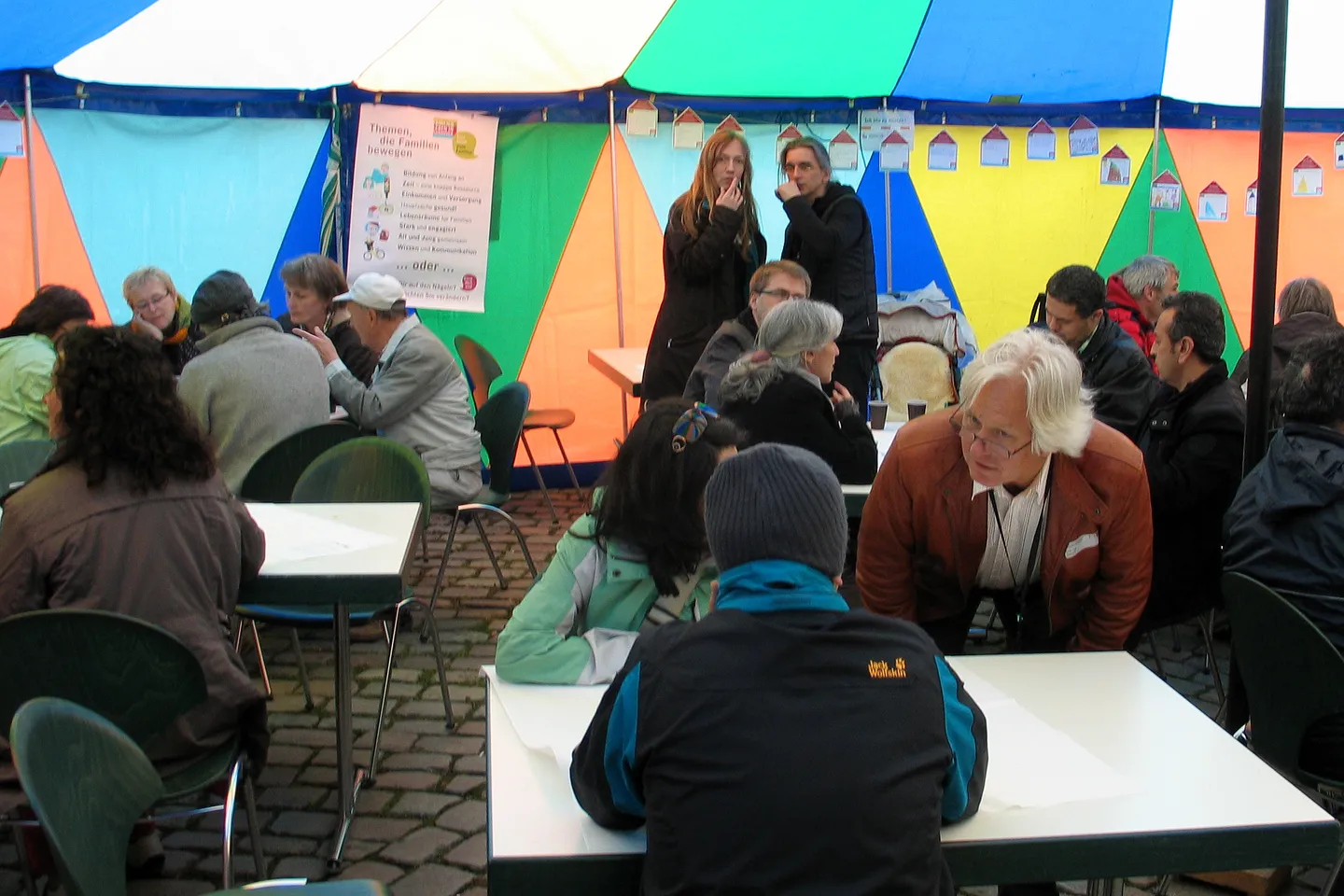
Plan World Café questions, rounds, table hosts and a harvest, then use the results honestly: as the views of those present, with clear decision boundaries and follow-up.
Method
Tell McKinsey's growth horizons apart from the futures version, then sort a portfolio, give each horizon its own management and check which transitional moves lead anywhere.
Framework
Plan a concept test around a decision, choose a suitable representation and distinguish understanding, preference, behaviour and operational evidence.
Playbook
Use Schein's cultural levels to investigate routines, stated values and assumptions without labelling people or pretending one survey explains a company.
Playbook
Make staged innovation funding practical: define a learning commitment, count scarce capacity and review evidence before making a larger promise.
Playbook
Connect innovation ambition with search fields, capabilities, resources and explicit exclusions, using a practical furniture-business example.
Playbook
Separate the object of innovation from its novelty and organisational impact, with examples that show why useful innovations often cross categories.
Comparison
Choose a focused collaboration, clarify what each partner contributes and plan how external knowledge will become usable work inside the business.
Playbook
Define useful search fields by connecting customer situations, company capabilities and external change, then decide what to explore and what to leave out.
Playbook
Go beyond six lists of trends: document signals, trace their business implications and decide which uncertainties deserve research or action.
Method
Explore plausible futures, stress-test one business decision and build a useful watchlist, with a worked parcel-shop example and clear limits.
Playbook
Build a focused scanning routine that distinguishes observations, patterns and explanations, checks counter-signals and feeds real innovation decisions.
Playbook
Turn a loose idea into a clear product or service concept: define the user, benefit, delivery conditions and assumptions before choosing a test.
Playbook
Clarify a change assignment before promising a workshop or rollout. Agree outcomes, decision rights, responsibilities, boundaries and when to revisit the brief.
Playbook
Use context, circular and hypothetical questions to explore workplace problems without smuggling in an answer. Includes a worked conversation and clear boundaries.
Method
Use a practical workplace example to distinguish correcting an action from reconsidering the goals, rules and assumptions that guide it.
Comparison
Plan around the questions people need answered, connect messages to real work, and give feedback an owner instead of just another inbox.
Playbook
Separate hard constraints, customer evidence and internal preferences, then choose a useful next test instead of a premature winner.
Playbook
Plan a useful handover by identifying critical know-how, choosing appropriate transfer methods and checking that the next person can actually use it.
Playbook
Plan and conduct useful discovery interviews, follow real experiences, and turn what people tell you into careful, actionable findings.
Playbook
Give a team space to develop ideas in writing, build on each other's suggestions and turn a full worksheet into a useful next step.
Method
Explore the different questions behind innovation and organizational change, and connect early experiments with the work of putting an idea into use.
Comparison
Before introducing a new way of working, find out whether people share the commitment, confidence and practical conditions to make it happen.
Playbook
Find the beliefs your idea depends on, examine the evidence behind them, and choose what to test before committing more time and money.
Method
Why a widely repeated failure statistic is a weak planning assumption, and how to evaluate change with clearer questions.
Perspective
Understand why creating a new technical solution and putting a meaningful change into use are different achievements.
Glossary
Move from a researched problem to a small set of concepts and an owned next test in one focused session.
Playbook
A careful guide to Awareness, Desire, Knowledge, Ability and Reinforcement, including where the model needs support.
Framework
Use Discover, Define, Develop and Deliver to connect problem exploration with practical testing.
Framework
Imagine a plan has failed, uncover plausible causes, and turn the most consequential risks into actions before launch.
Method
Identify who is affected, who can influence a change, and which conversations must happen before the next decision.
Method
Run a participant-led conversation with a visible topic queue, simple voting, time checks, and clear follow-ups.
Method
How to diagnose, support and sustain changes in everyday work without reducing adoption to communication.
Foundation guide
A practical introduction to turning opportunities into implemented changes, with clear decisions, experiments and measures.
Foundation guide
Try a different area, subtopic or format.
Photography credits · Images illustrate working materials and settings, not reported case studies.