In this guide
- 01Understand
- 02Explore
- 03Apply
- 04Reflect
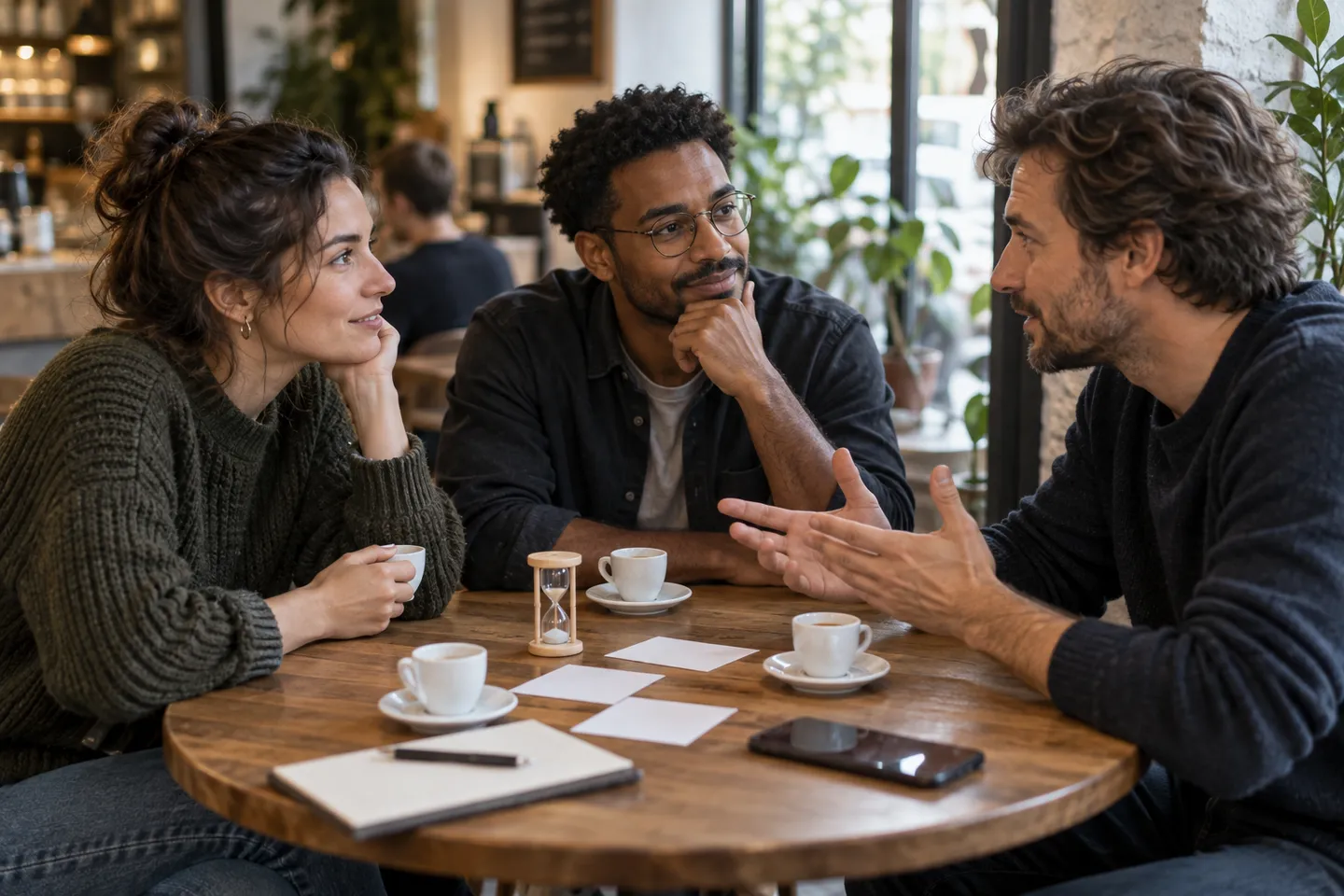
A World Café is a way of holding many small conversations at once. People sit four or five to a table, talk through a question that matters to them for about 20 minutes, then move to new tables and carry what they heard with them. After several rounds, the whole room looks for patterns together. The format is useful when many perspectives need to meet each other, not when you need a verdict.
A café can show what the people present notice, care about and disagree on, and it can surface ideas nobody in the planning group had. It cannot tell you what everyone thinks, and a decision does not become legitimate just because many people were in the room. The most useful cafés say so at the start and later show participants what happened to their contributions.
This guide follows a fictional example. A regional museum is rethinking its volunteer programme: long-serving volunteers are getting older, new ones leave within months and staff feel stretched. About 36 people will take part, including long-serving and new volunteers, front-of-house and collections staff, and a few visitors. Before the invitation goes out, the director has written down which decisions stay with the board and which ideas the programme team can act on.
Where the format comes from and what it assumes
The World Café’s own history page traces the format to 1995 and the Mill Valley, California, home of Juanita Brown and David Isaacs. Rain disrupted a planned large-circle dialogue, so about two dozen participants formed small table conversations, wrote on makeshift paper tablecloths and periodically switched tables. Harvesting those conversations helped them notice patterns that shaped later rounds. Tablecloths, rotation and harvest remain the core of the method.
Brown and Isaacs set out the approach in The World Café: Shaping Our Futures Through Conversations That Matter, which its publisher describes as offering seven core design principles and hosting advice for groups of any size. The current design principles page lists them as: clarify the context; create hospitable space; explore questions that matter; encourage everyone’s contribution; connect diverse perspectives; listen together for patterns and insights; and share collective discoveries. The organisation’s printable Café to Go host guide calls the first one “set the context”; the intent is the same.
These principles are the originators’ account of good practice. They explain what the method intends, not that it produces better outcomes than other formats. Treat them as design questions to answer for your own situation.
Decide what the café is for, and what it cannot decide
The first principle asks hosts to consider why people are being brought together, who should be part of the conversation and what kind of harvest would be useful. Add a question the principles leave implicit: what will happen to what people say, and who can act on it?
The museum director’s note to invitees is short. The board decides the budget, including any paid coordinator hours, the expenses policy and opening times. The programme team can change how new volunteers are welcomed and inducted, how the rota is organised, how volunteers and staff communicate and how contributions are recognised. Anything raised about board matters will be passed on in writing, labelled as views from the café, with a date for a response.
That note stops people designing something nobody can approve and avoids implying that 36 people are being asked to decide. It also makes follow-up checkable: participants can see whether the team acted on what was within its reach. If you are running a café on someone else’s behalf, agree who can decide what before you design the questions. A café used to endorse a settled plan can do more damage than holding none.
The US Environmental Protection Agency’s public participation guide on World Cafés is direct about one limit: the format is not appropriate for obtaining formal comment on proposed plans. It places cafés at the “involve” and “collaborate” levels of participation.
Write questions that travel between tables
The questions carry the event. Café to Go recommends open-ended questions without yes-or-no answers. It says they should invite inquiry rather than advocacy, and suggests trying drafts on some of the people who will attend. A café can stay with one question or use a different question each round to deepen the conversation.
For the museum, a sequence works well: experience first, then patterns, then what is within the programme team’s reach. The last question keeps the harvest connected to the director’s boundaries.
| Weak question | What goes wrong | Stronger question |
|---|---|---|
| How do we get more volunteers? | Produces a wish list and skips why people leave | Think of your first weeks here. What made it easier or harder to come back? |
| Don’t you agree the paper rota needs replacing? | Leading, and answerable with yes or no | When has the rota worked well for you, and when has it got in the way? |
| Why do new volunteers leave? | Asks people to speak for absent others and can sound like blame | What have you noticed that helps someone feel they belong here, or not? |
| What should the board do about expenses? | Asks the room to settle something it cannot decide | What should the board understand about the cost of volunteering here? |
The programme lead tried the draft questions on two volunteers. The newer one said “Why do new volunteers leave?” felt like being asked to explain a failure, and that long-serving volunteers would end up guessing at other people’s reasons. The question was rewritten around observation and belonging.
Good café questions often borrow from systemic questioning: what does this look like from another role, and what is different when it works? At a café table, someone from that other role may be sitting opposite to check the guess, which is one of the format’s real strengths.
Invite a mix and set up a room that works
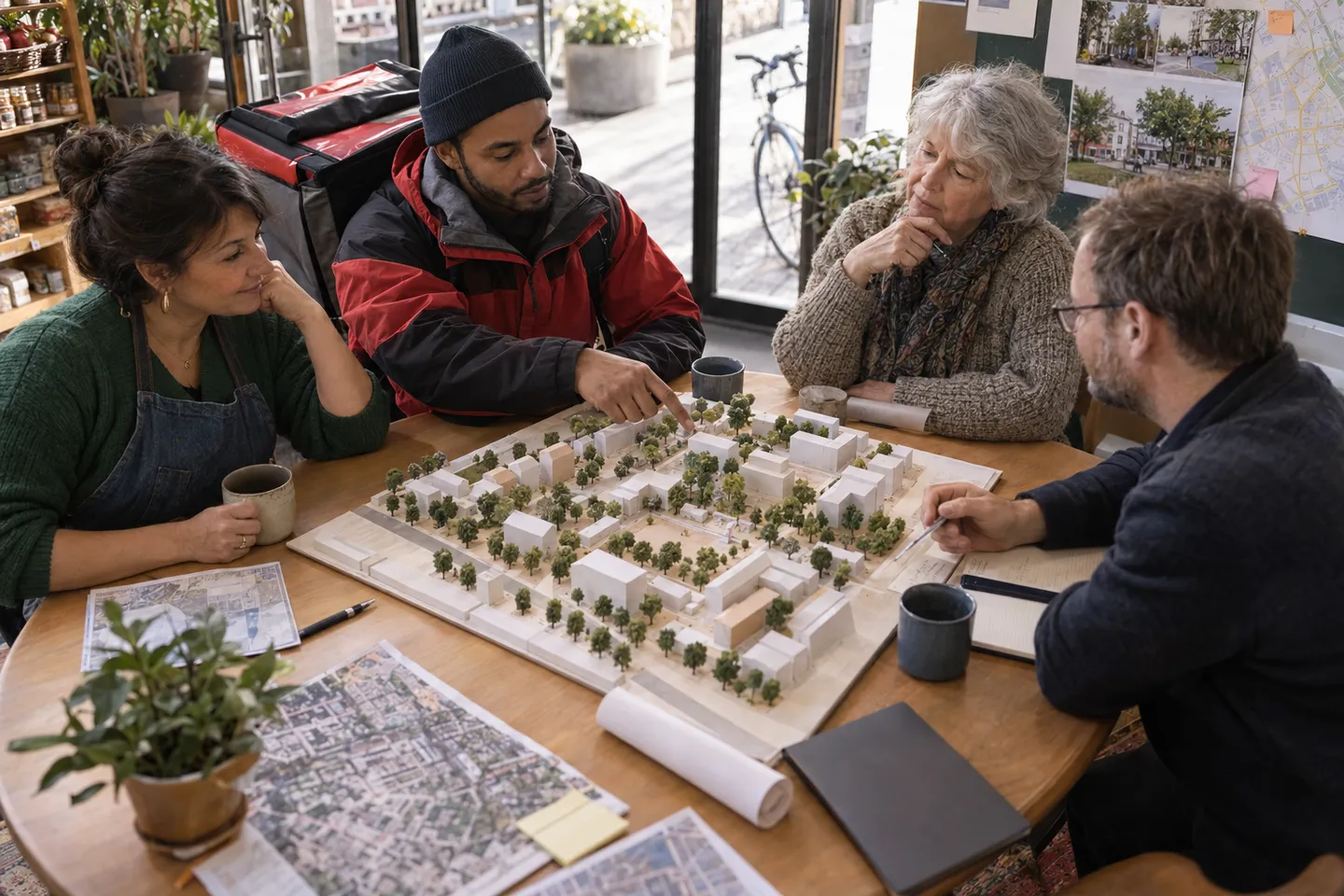
Who is in the room determines what the harvest can say. Participedia’s entry notes that the host decides whom to invite and how. That suits a purposeful conversation, but it limits what the results represent. Use stakeholder mapping to check who is affected and who usually goes unheard. The museum invited volunteers who had left in the past year as well as current ones, weekday and weekend volunteers, and visitors from the family programme rather than only members.
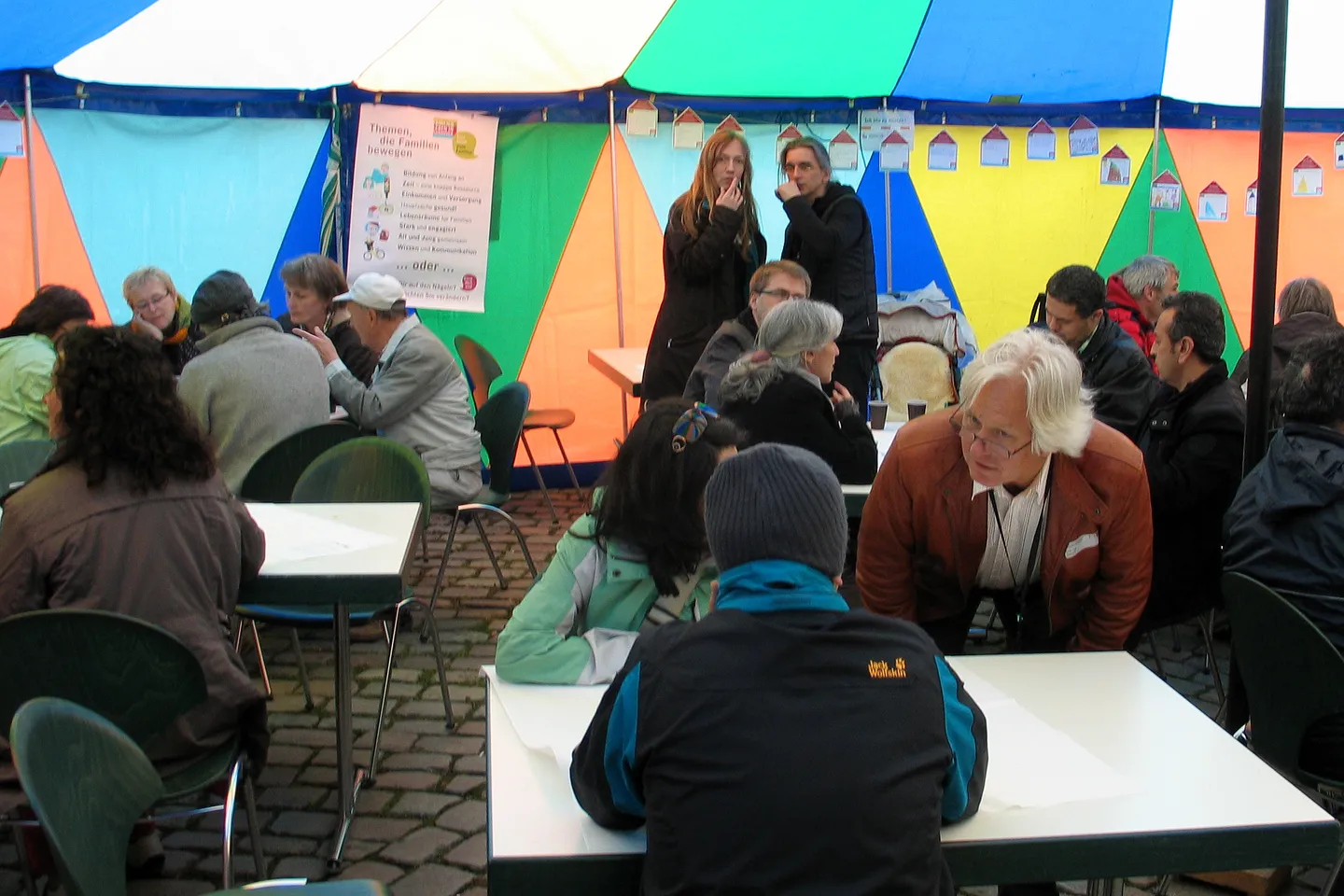
Café to Go suggests four people per table and five at most. Fewer than four may not bring enough perspectives together; more than five limits personal interaction. Mix roles and lengths of service at each table. Cover tables with large sheets of paper and put out coloured pens so people can write and draw as they talk. Refreshments are part of the method’s hospitality, not decoration.
Plan for access. Nine tables talking at once is loud, and several long-serving volunteers find background noise difficult. The museum team used the education room and the adjoining gallery to space tables out, kept one quieter table near the door and printed each round’s question in large type.
Hospitable space also means people can speak without penalty. Collections staff supervise some volunteers, so nobody sat with their own supervisor in the first round. The team also offered a route for comments people preferred not to make at a table, with an honest explanation of who would read them. Psychological safety is built over time by how people are treated when they speak up; a well-arranged room cannot create it on its own.
Run the rounds: hosts, travellers and timing
Café to Go lists the café host’s tasks: welcome people and explain the purpose, keep the question visible, explain the etiquette, move among tables, signal when it is time to change and make sure key insights are recorded. It also says there are no facilitators in a World Café, only hosts; everyone at a table shares responsibility for the conversation.
Café to Go suggests at least three rounds of about 20 minutes, while Participedia describes rounds of 20 to 30 minutes. When a round ends, one person stays behind as table host and the others travel to different tables, carrying key ideas with them. The table host briefly summarises the previous conversation so newcomers can build on it.
Sources differ on who stays. Café to Go recommends choosing a new table host at the end of each round and says you may decide not to use table hosts at all. Participedia and the EPA guide describe a host who stays at the same table throughout. A fixed host gives continuity, but their summaries shape what every later group hears. A rotating host spreads that influence. The museum chose rotation so that one familiar voice did not filter every newcomer’s comment.
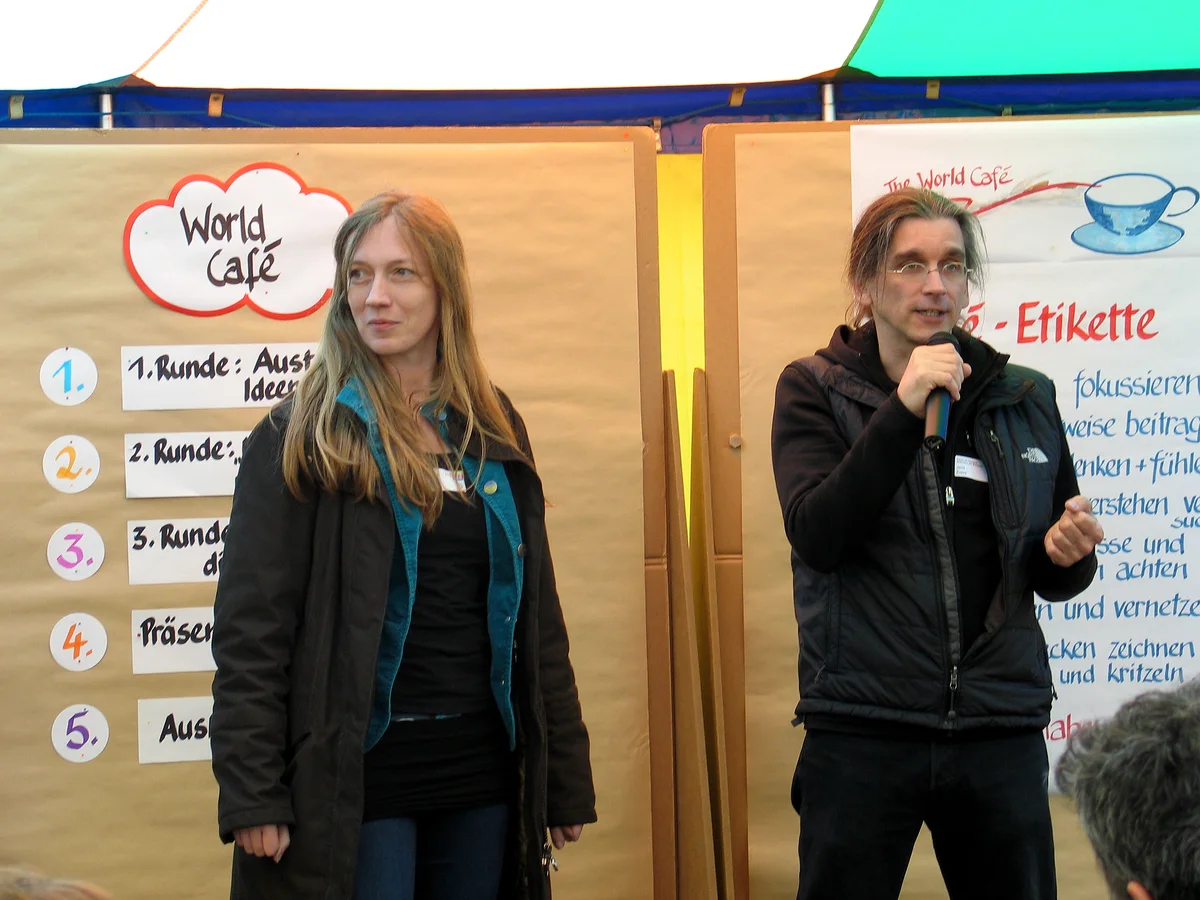
In the second round, the café host noticed one table where a long-serving volunteer and a collections officer were doing most of the talking. She did not take the table over. Before the next round, she reminded everyone that listening is a legitimate way to take part, as the design principles allow, and that the paper is there for people who would rather write than speak. In their analysis of cafés used to set primary-care research priorities, MacFarlane and colleagues describe self-recording for a similar reason: less confident participants could write or draw a contribution without having to defend it aloud.
A three-hour agenda for the museum café
The EPA guide describes cafés as typically lasting two to three hours. Protect the harvest: if rounds overrun, shorten the third round rather than the closing conversation.
| Time | Activity | Purpose |
|---|---|---|
| 0:00–0:15 | Arrival, drinks and seating at mixed tables | Settle in; mix roles from the start |
| 0:15–0:30 | Welcome: purpose, who decides what, how results will be used, feedback date | Give honest context before anyone speaks |
| 0:30–0:55 | Round 1: first weeks, and what made it easier or harder to come back | Ground the conversation in experience |
| 0:55–1:20 | Round 2 at new tables: what helps someone feel they belong, or not | Connect experiences into patterns |
| 1:20–1:35 | Break | Rest and informal conversation |
| 1:35–2:00 | Round 3: what the programme team could try in three months, and how we would know it helped | Point towards action within reach |
| 2:00–2:15 | Silent reflection and a walk around the tablecloths | Let everyone see every table’s notes |
| 2:15–2:45 | Whole-group harvest with a graphic recorder | Name patterns, differences and open questions |
| 2:45–2:55 | Close: next steps, owners and feedback date | Make the follow-up explicit |
Harvest what the room found, not what you hoped to hear
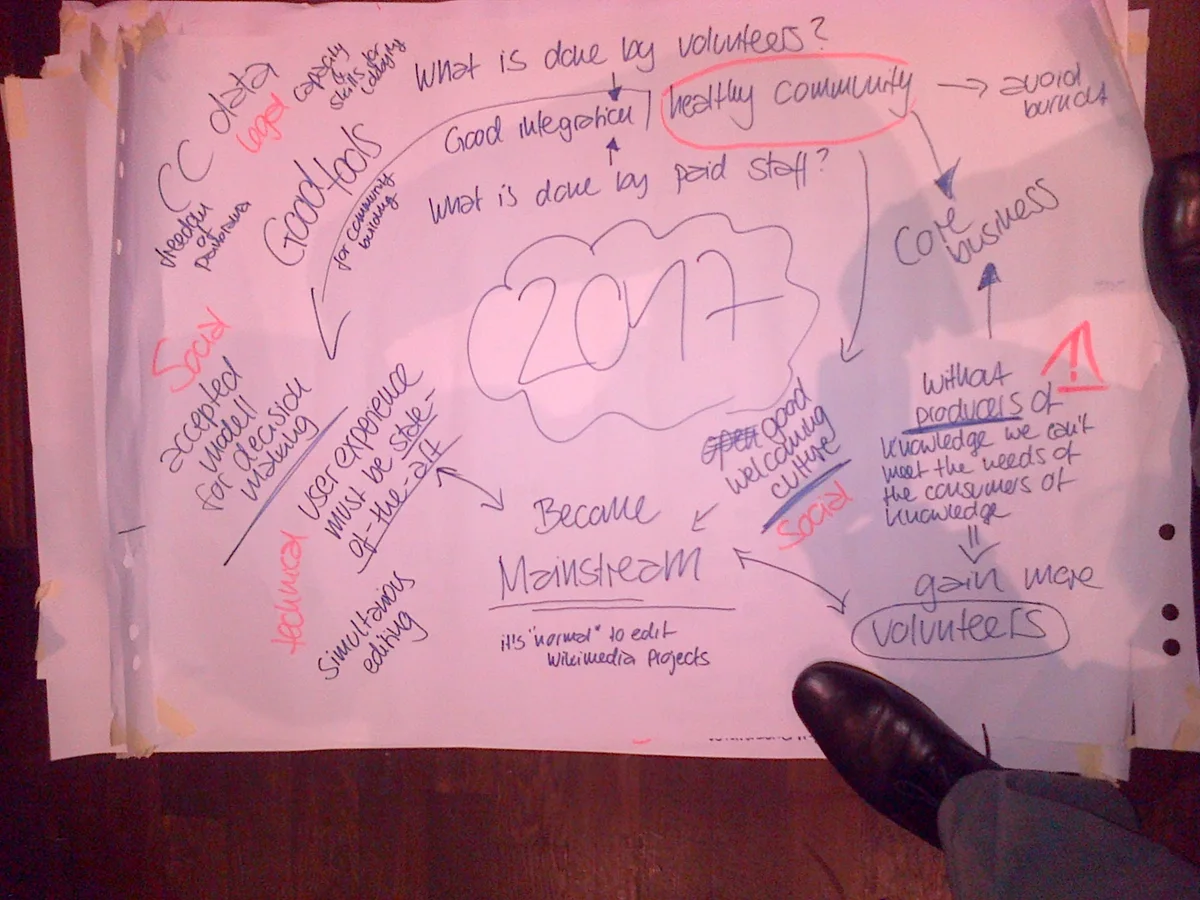
The harvest makes patterns visible to everyone in a whole-group conversation. Café to Go suggests a few minutes of silent reflection first. It then describes several ways to make collective knowledge visible: a graphic recorder, a gallery tour of tablecloths on the walls, posted insights, clusters of related notes and a written story for people who were not there.
Synthesis is where a café most easily goes wrong. Whoever holds the pen shapes the summary, and a tidy summary can erase disagreement. MacFarlane and colleagues also describe grouping similar responses under one representative phrase while keeping unique responses unique. That is a sound rule: combine what genuinely overlaps, keep outliers visible and record open questions as questions.
In the museum harvest, three patterns came up at most tables. New volunteers learned practical things by chance: where the keys are kept, whom to ask, which shifts were informally “owned”. Long-serving volunteers felt their knowledge was rarely asked for, though many were glad to pass it on. Front-of-house staff were covering gaps when newcomers stopped coming. There was disagreement too. Some long-serving volunteers valued the paper rota and worried an online system would push them out; newer ones found it almost impossible to join.
Near the end, someone proposed a show of hands on replacing the rota. The host recorded both positions and explained why a vote would not settle it: the 36 people present were not all the volunteers, and the rota affected people who were absent. The question went into the follow-up as something to test.
Turn the harvest into decisions and feedback
A week later, the programme team sorted the tablecloths, graphic record and harvest notes into three groups: matters within its remit, matters for the board and questions needing more information.
Within its remit, it decided to pair each new volunteer with an experienced one for their first four shifts and to write a short first-month guide with long-serving volunteers. Our guide to knowledge transfer when someone changes roles covers a similar problem: what a newcomer needs to be able to do, not just to know. Two teams would trial a shared online calendar alongside the paper rota and report what worked.
For the board, the team wrote a one-page note: several newer volunteers without cars had named bus fares as a reason they came less often. The note said plainly that this was raised by some people at the café, not a survey of all volunteers, and asked for a decision at the next board meeting. The team did not announce that “volunteers want an online rota”.
Give a feedback date at the start and keep it. The museum promised a written summary within two weeks and an update at the volunteer meeting six weeks later. The summary covered attendance by role, patterns and disagreements, what the team would do, what went to the board and what it would not act on, with reasons. After their Irish cafés, MacFarlane and colleagues emailed preliminary findings to all participants and invited feedback before finalising, which lets people correct a summary before it becomes the official version.
Treat objections raised at the café as information. The worry about an online rota says something about how the current rota distributes certainty and standing; working with resistance to change explores that. For later updates, use your change communication plan so the follow-up also reaches people who were not in the room.
When a World Café is the wrong format
Do not run a café when the decision has already been made; explain the decision and hold a conversation about implementation instead. Avoid it in an acute conflict that needs mediation, and in a crisis where people need clear instructions and quick decisions. Avoid it too when people cannot speak freely because of power, fear of consequences or safety concerns. Mixed seating does not remove a reporting line.
Nor is a café a way to find out what a whole population thinks. The people who come are those who were invited and could attend. If you need representative views, use a sampling approach designed for that, and treat café outputs as the views of those present.
Neighbouring formats suit different jobs. Lean Coffee lets participants set the agenda and moves through short, timeboxed topics, which suits a small group with many different questions. Brainwriting collects ideas in writing before discussion, which helps when the task is generating options for a defined problem. When a café has surfaced one clear problem worth solving, a focused 90-minute idea workshop is a better next step than another open conversation. Formal consultation, with a specific proposal, a response period and a published reply, is the right route when people need to comment on a plan.
Evidence and limitations
Most published guidance on World Café comes from its originators and practitioners. Participedia’s crowd-sourced entry classifies its decision method as idea generation and observes that a café “is what the host(s) makes it”, which cuts both ways.
The research cited here mostly treats the café as a way to involve people in research or gather qualitative material. Löhr, Weinhardt and Sieber propose it as a participatory data-collection method for large groups. Comparing it with semi-structured interviews and focus groups, they argue that it complements those methods and helps explore and verify themes when there are many participants. Fouché and Light describe a café within a practice-based social work project in Auckland in 2006 and 2007 and reflect on its perceived value. MacFarlane and colleagues adapted the format with community and health-care stakeholders in Ireland and the USA; in one setting, tablecloths moved between tables while language groups stayed with their scribe. They note that their analysis rested on their own observations rather than evaluation data from participants.
These studies show that the format can be adapted and used in research settings. They do not show that a café leads to better organisational decisions than other approaches. Results depend on the questions, the mix of people, the hosts and the synthesis. The museum example is invented to illustrate those choices and reports no real outcomes.
Sources:
- The World Café Community Foundation (n.d.). History.
- The World Café Community Foundation (n.d.). Design Principles.
- The World Café Community Foundation (2015). Café to Go: A quick reference guide for hosting World Café.
- Juanita Brown and David Isaacs with the World Café Community (2005). The World Café: Shaping Our Futures Through Conversations That Matter.
- United States Environmental Protection Agency (2025). Public Participation Guide: World Cafés.
- Participedia (n.d.). The World Café.
- Katharina Löhr, Michael Weinhardt and Stefan Sieber (2020). The “World Café” as a Participatory Method for Collecting Qualitative Data.
- Christa Fouché and Glenda Light (2011). An invitation to dialogue: ‘The World Café’ in social work research.
- Anne MacFarlane, Rose Galvin, Madeleine O’Sullivan, Chris McInerney, Eoghan Meagher, Daniel Burke and Joseph W. LeMaster (2017). Participatory methods for research prioritization in primary care: an analysis of the World Café approach in Ireland and the USA.