In this guide
- 01Define parameters
- 02List alternative values
- 03Check combinations
- 04Investigate complete concepts
Morphological analysis explores different concepts by separating a problem into parameters, listing possible options for each and combining those options deliberately. A small morphological box helps a team escape its first complete solution and see which design choices it has been bundling together.
Use it when the challenge is reasonably bounded and several dimensions can vary. If the team does not understand the problem or the user situation, begin with discovery and problem framing. A tidy option table cannot repair an unsupported problem definition.
Where the method comes from
Fritz Zwicky developed the morphological approach; Tom Ritchey’s introduction to General Morphological Analysis explains its use in multidimensional problems that are not necessarily quantified. Parameters and their possible values define a space of configurations. Consistency assessment helps identify combinations that do not fit together.
The compact concept-design box below is a simplified application. Ritchey’s paper on computer-aided morphological analysis describes a more extensive problem-structuring method. Completing a small table does not mean that a team has performed that whole analysis or explored every possible solution.
The method organizes possibilities. It does not establish demand, technical performance or the probability that a configuration will succeed. Those questions require further evidence.
Build a small morphological box
Consider a hypothetical team developing a reusable container for local deliveries of delicate objects. It wants to explore how the container closes, how people carry it and how it protects the contents. These parameters concern distinct choices in one bounded concept.
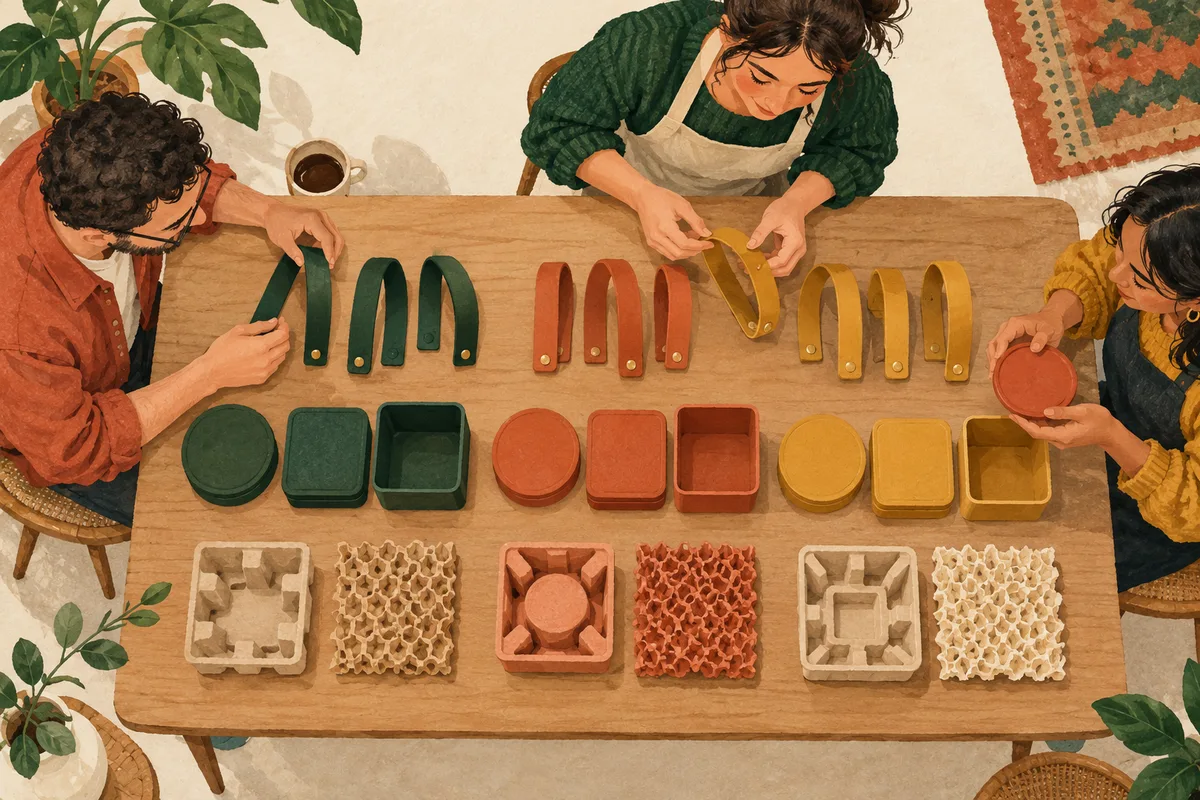
Start with a clear sentence: the container must help a delivery worker carry delicate objects and return the empty packaging for reuse. Ask whether that intended task is supported by customer-needs evidence, and list the conditions the team is currently assuming.
An initial box might look like this:
| Parameter | Option A | Option B | Option C |
|---|---|---|---|
| Closure | Hinged lid | Separate clipped lid | Fold-over cover |
| Carrying | Two side grips | Single top handle | Detachable shoulder strap |
| Protection | Removable paper insert | Washable textile sleeve | Adjustable rigid dividers |
| Empty return | Stack intact | Nest without insert | Fold the body flat |
The table offers three options for each of four parameters, producing 3 × 3 × 3 × 3 = 81 formal combinations. That arithmetic counts selections, not feasible concepts. Some options may conflict, and some useful possibilities may be absent from the box.
Make the parameters useful
Each parameter should answer a different design question. “Cheap”, “premium” and “green” are weak rows because their meanings overlap and they do not specify what changes. Ask which material, activity or arrangement would make a concept cheaper or easier to recover, then decide whether it belongs in the box or in later evaluation criteria.
Keep options within a row comparable. If one closure option is a physical mechanism and another is “delightful experience”, the row mixes a possible means with an intended outcome. Rewrite it before combining anything.
Check that the parameters do not quietly depend on one preferred design. A row called “type of zip” excludes concepts without a zip. “Closure” leaves more room. Equally, avoid making the problem so broad that each row describes an entire business model. Split the inquiry if the combinations cease to describe a coherent object or service.
Invite expertise from use, production and servicing. A designer may notice an omitted closure mechanism; a delivery worker may explain why carrying with both hands is impossible on a particular route. Record the reason for adding or removing an option so later reviewers can understand the boundary.
Examine compatibility before choosing favourites
Select one option from each row and ask whether the resulting concept can work as described. A single top handle may require reinforcement in a lid. A fold-flat body may not work with a permanently fixed divider. A textile sleeve may need a drying arrangement that the return process lacks.
Distinguish different objections. A logical incompatibility, an engineering uncertainty and a commercial preference should not all be marked impossible. Keep uncertain combinations visible with a question and a route to investigation. Otherwise a current limitation can become an unjustified permanent exclusion.
Ritchey’s consistency work concerns whether options can coexist; it is not a causal model. Pairwise compatibility also does not automatically prove that a complete configuration will function. Several individually compatible choices can still create a difficult system when combined.
For a small box, record important incompatibilities beside the table. For a large policy or systems problem, consider specialist facilitation and suitable tooling. Increasing the number of dimensions can rapidly make manual inspection impractical.
Turn combinations into testable concepts
Choose a few meaningfully different configurations to develop. In the fictional example, one might use a hinged lid, side grips, removable paper protection and intact stacking. Another might combine a clipped lid, a top handle, textile protection and nesting. Describe the complete use situation rather than circulating only their selected letters.

Make a rough model or walkthrough showing how someone packs, carries, opens and returns each option. The Design Council’s Double Diamond distinguishes developing possible responses from testing them. The box belongs within that wider inquiry; it does not authorize selecting a winner before understanding use.
Use a short concept record:
| Field | What to write |
|---|---|
| Configuration | One explicit choice from every parameter |
| Intended task | Who uses it, where and with what contents |
| Key difference | What distinguishes it from the other concepts |
| Compatibility concern | The combination that may not work |
| Important assumption | What must be true beyond the design itself |
| Next inquiry | The observation or test needed before commitment |
If none of the concepts differs meaningfully, revisit the parameters. The team may have varied cosmetic details while preserving one underlying arrangement. Reverse brainstorming can help expose overlooked ways the task could fail, while concept development helps give an option enough detail to examine.
Evaluate separately and keep the reasoning visible
NASA’s decision-analysis guidance distinguishes defining alternatives from evaluating them against decision criteria. Follow that separation here. First make the options coherent; then compare them using criteria relevant to the task, including uncertainty and operating dependencies.
Do not reward an option because it occupies the most unusual combination. Novelty is different from usefulness. Nor should a team choose an option merely because it scores well on a criterion it cannot yet measure. A weighted decision matrix may support a transparent comparison, but weak inputs remain weak evidence.
Use assumption mapping to identify which uncertainty deserves attention first. If nobody knows whether customers can store the empty container, a detailed comparison of handle finishes may be premature.
Evidence limits and the next session
The fictional box is an original teaching example. Its combinations have not been engineered, tested or demonstrated to be safe or desirable. The primary sources establish the morphological approach and its logic, not the effectiveness of this particular container exercise.
Bring the next session one problem sentence, a small set of distinct parameters and the people who understand use and delivery. Leave with complete candidate concepts, recorded exclusions and one important uncertainty for each. The next useful artifact is evidence about those concepts, rather than a larger box filled with more selections.
Sources:
- Tom Ritchey (2013). General Morphological Analysis.
- Tom Ritchey (2006). Problem Structuring using Computer-Aided Morphological Analysis.
- Design Council (n.d.). The Double Diamond.
- NASA (n.d.). 6.8 Decision Analysis.