
In this guide
- 01Name the uncertainty
- 02Find relevant people
- 03Explore a real situation
- 04Interpret and follow up
A useful customer interview helps you understand a real situation: what someone was trying to do, what happened, which alternatives they considered and where the difficulty lay. It is not a presentation followed by a request for approval. The difference becomes visible in the questions you ask and the conclusions you are willing to draw.
Consider a hypothetical equipment-hire business wondering whether customers need an app to manage collections. Asking “Would an app make this easier?” puts the proposed answer in the question. Exploring someone’s most recent collection may reveal a different issue: uncertainty about readiness, an awkward pickup window or the difficulty of arranging transport. The app may eventually help, but it has not earned its place yet.
Start with a decision, not a questionnaire
Write down the decision the research should inform. For the hire business, a useful initial decision is which part of the collection experience deserves further investigation. “Prove that customers want our app” is not a neutral research objective.
The GOV.UK guidance on planning research links research questions, user groups and appropriate activities. Apply that connection before scheduling interviews. Which uncertainty matters now, whose experience could illuminate it, and is talking an appropriate way to learn about it?
In this example, ask how customers decide when to leave for a collection, what information they check and what they do when arrangements change. Separately, ask staff how readiness is established. A customer may know exactly what a confusing message meant to them without knowing why the business sent it. Neither perspective replaces the other.
This is discovery work within the Double Diamond. If the question is instead whether a particular screen can be used successfully, plan a task-based usability test. If the decision needs an estimate of how common a problem is across the market, an exploratory interview round alone cannot provide that estimate.
Recruit for relevant differences
Choose participants because of the experience you need to understand, not simply because they are easy to contact. For the hypothetical business, useful contrasts might include a first-time customer, someone who hires regularly, someone who rearranged a collection and someone who gave up before collecting. These are proposed sampling considerations, not a claim that four people cover the market.
Keep a simple recruitment record: the relevant experience, how recently it happened, how the person was found and which important perspective remains absent. An invitation sent only to enthusiastic repeat customers leaves an obvious gap. A list supplied by sales may also emphasize people with an established relationship to the business.
Stakeholder mapping can help identify missing roles, particularly when the person booking is not the person collecting, using or paying for the equipment. Do not turn that map into a substitute for recruitment criteria. An influential buyer and an occasional user may encounter very different problems.
Plan in rounds so that emerging questions can change whom you contact next. Document the limits of each round instead of declaring a universal number of interviews “enough.” Avoid making statistical claims from a small, purposively recruited group.
Make participation clear and comfortable
Explain the research purpose, who is observing, whether you want to record and how the material will be used. Participation and recording should not come as a surprise halfway through the conversation. The GOV.UK informed-consent guidance sets out these practical responsibilities, including voluntary participation and accessible information.
Use your organization’s approved arrangements for consent, storage, retention and withdrawal, and involve its responsible privacy specialist where needed. This guide is not a consent template or jurisdiction-specific legal advice. Do not copy a government form and assume that it covers every commercial research setting.
For the hire example, make clear that the interview is not a sales call and does not affect the customer’s booking. Offer a workable time and communication format. If a participant wants to show a confirmation message, ask them to hide unrelated personal information. You usually need to understand the sequence, not collect their entire inbox.
Build a guide around one recent experience
A discussion guide keeps the conversation coherent without requiring every participant to follow an identical script. The GOV.UK in-depth interview guidance recommends open, neutral questions, concrete examples and room for follow-up. It also recommends trying the guide before using it in research.
For the hypothetical collection service, the following is an original guide outline:
- Establish the situation: what equipment was needed, for what task and under what time constraints?
- Reconstruct the most recent collection from making the arrangement to leaving with the equipment.
- Explore a moment that required checking, waiting, changing plans or getting help.
- Ask what alternatives the person considered and what happened afterwards.
- Summarize the account, invite corrections and ask what important detail is missing.
Keep the solution presentation out of this part of the conversation. If you later want feedback on a concept, introduce it as a separate activity and record that the participant has now been exposed to your proposal. A reaction to a supplied concept is different evidence from a problem someone described without prompting.

Follow the story without supplying it
Here is an invented exchange to show the difference between a leading question and a useful follow-up. It is not a transcript or a quotation from a real customer.
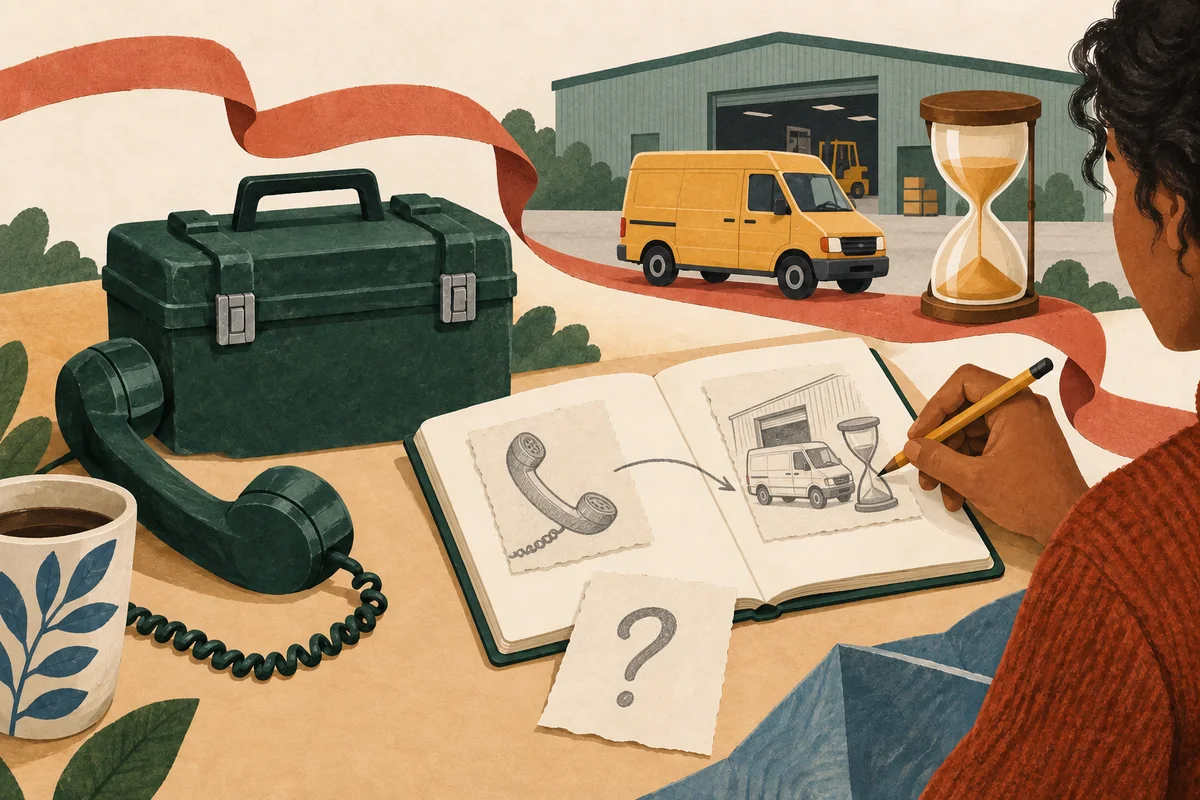
The interviewer asks what happened before the participant left to collect the equipment. The participant says they phoned the branch. Rather than concluding that the confirmation message was inadequate, the interviewer asks what they wanted to find out on that call.
Suppose the participant explains that a colleague was lending them a van, but only for a short period. The next useful question is what information would have affected their departure—not whether they would prefer a push notification. Their concern might be the complete order being ready, the branch closing time or whether the item would fit in the van.
Follow the sequence. What did they know before calling? What changed afterwards? Did someone else make the booking? If the participant describes a vague pattern, invite a specific instance. If they cannot remember, record that limit rather than repeatedly pressing until an answer sounds definite.
Silence can give someone space to think. A short summary can reveal a misunderstanding: “I understand that you had a collection confirmation, but still needed to coordinate transport. Have I got that right?” That is a check of the interviewer’s interpretation, not a request to endorse the product team’s theory.
Keep accounts, observations and interpretations separate
An interview usually gives you someone’s account of an event. Watching them look up a message during the session is a direct observation of that activity, but it does not let you observe the original collection retrospectively. Make the difference clear in your notes.
The GOV.UK analysis guidance distinguishes observations, findings and subsequent actions. Use separate fields for what was said or seen, what you think it may mean and what should happen next. Preserve a participant reference and enough context to revisit the interpretation.
In our invented example, a note could say that a participant reported phoning before leaving because transport availability was limited. “Customers do not trust our messages” is an interpretation several steps beyond that account. It might be worth investigating, but it should not enter a presentation as an established finding.
After each round, compare accounts for similarities and meaningful differences. Invite another researcher or observer to question your interpretation. Keep contradictory examples visible. A participant who collected without any uncertainty may reveal a useful distinction between order types, not an inconvenient exception to discard.
When describing a pattern, say whom it concerns and what supports it. A formulation such as “Several participants in this round described checking readiness before arranging transport” remains tied to the research. Rewriting it as “Customers need an app” changes both the scope and the claim.
End with an accountable research decision
For the hire business, imagine that the next step is to investigate how readiness confirmations are produced. A useful research note would name that question, point to the interview accounts that motivated it, identify the missing staff perspective and state who will organize the follow-up.
There may be more than one plausible explanation. Transport coordination, uncertainty about accessories and conflicting messages could require different responses. Return to assumption mapping if the team is tempted to treat a preferred explanation as settled. Once the problem is sufficiently understood, brainwriting can help generate alternative responses.
An interview round is complete when its material is organized, its limitations are visible and someone can use the findings in a decision. A folder of recordings and a collection of memorable quotes do not accomplish that on their own.
The limits of a good conversation
People may misremember an event, simplify a complicated sequence or respond politely to an interviewer. Recruitment, question wording and interpretation also shape the material. Good interviewing makes these influences easier to examine; it does not eliminate them.
There is no universal interview script that settles these questions for every setting. For specialist, sensitive or high-stakes research, use suitably experienced researchers and the relevant review process.
The aim is not to avoid every imperfect answer. It is to leave with a more careful understanding of the situation than you brought in—and with fewer unsupported assumptions disguised as customer insight.
Sources:
- GOV.UK User research community (2017). Using in-depth interviews.
- GOV.UK User research community (2018). Plan user research for your service.
- GOV.UK User research community (2016). Analyse a research session.
- GOV.UK User research community (2018). Getting informed consent for user research.