In this guide
- 01Define the task
- 02Choose the thinking move
- 03Check participation needs
- 04Plan the next decision
Choose an ideation method by the work you need the group to do. Brainwriting helps develop several responses in parallel. Reverse brainstorming explores how a problem could become worse, then translates those mechanisms into possible improvements. A morphological table combines different ways of performing a service’s functions. Six Thinking Hats structures the examination of one question through different modes of thinking.
These methods produce different things. A pile of suggestions, a set of failure mechanisms, a collection of service configurations and a record of perspectives are useful at different points. None is a substitute for evidence about customers or permission to implement a proposal.
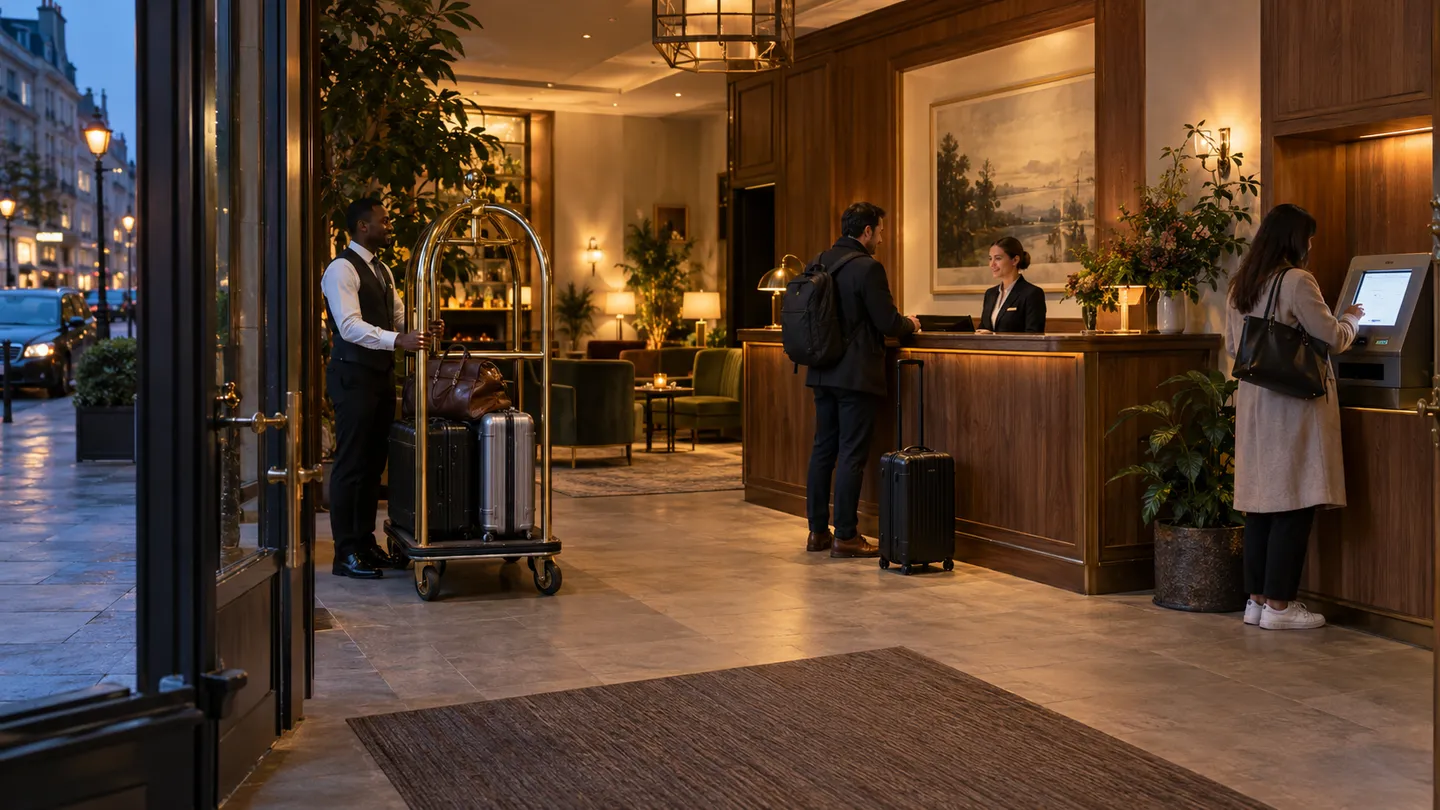
Consider a fictional small hotel trying to improve arrivals. Some guests wait at the desk, some want a quick key collection and others need personal help with luggage or access. The manager initially asks for “a creative workshop”. The more useful question is which uncertainty the team should address first. All hotel situations and outputs below are hypothetical.
Match the method to the work
Begin with a verb and an output: generate different responses, challenge a familiar explanation, combine service components, or examine a proposed choice. Then decide how the output will inform the next commitment. “Have an energetic afternoon” is too vague to guide either choice.
The following comparison is an editorial selection aid, not a ranking derived from a head-to-head study.
| Work the group needs to do | Starting method | Useful output | Main caution |
|---|---|---|---|
| Develop several responses to a researched problem | Brainwriting | Separate ideas and extensions | Repetition can look like variety |
| Escape a habitual response to a recurring difficulty | Reverse brainstorming | Worsening mechanisms translated into options | The opposite is not automatically a remedy |
| Combine alternatives for known service functions | Morphological table | Distinct, internally coherent configurations | Missing functions hide missing options |
| Examine one proposal without alternating argument and rebuttal | Six Thinking Hats | Information, feelings, benefits, risks and alternatives | A perspective is not evidence or a personality type |

In the hotel, those are different tasks. The receptionist needs alternative ways to reduce waiting. The porter needs a workable combination of arrival contact and luggage help. The manager needs to examine whether evening self-service is acceptable. Asking one activity to settle all three encourages superficial coverage.
Check whether the question is ready for ideation
An ill-defined problem remains ill-defined when written on a colourful worksheet. “How can we make arrivals digital?” already commits the hotel to a solution category. “How can guests complete the necessary arrival steps without avoidable waiting?” leaves several responses available.
The Design Council’s Double Diamond distinguishes understanding and defining a problem from developing different responses and testing them. Place the activity within that movement from discovery to development. A creativity method cannot establish which inconvenience matters most.
Bring concrete material into the session: recent arrival accounts, observed delays, access needs and known operating constraints. The hotel might find that waiting usually occurs when guests cannot locate a booking reference, rather than because the counter lacks a screen. That finding would change the brief.
If such material is missing, start with interviews about recent experiences. GOV.UK’s research-planning guidance links questions, relevant participants and suitable activities. Its principle is useful here: choose a method because it can answer the question, rather than because it is familiar.
Write the constraints separately from assumptions. “We have one receptionist after 8 pm” is a current staffing condition. “Older guests never use self-service” is an unsupported generalisation. Treating both as fixed would quietly narrow the possible responses.
Use brainwriting when you need several starting points
Choose brainwriting and its 6-3-5 format when participants understand the problem and need room to develop responses before discussion. Written contribution allows several people to work during the same interval. Passing suggestions on creates an opportunity to build on another person’s idea.
The Hochschule Luzern method description sets out that exchange: people write ideas, pass the worksheet and extend what they receive. It describes the familiar six-person version while allowing adaptations. The arithmetic of available writing spaces says nothing about the number of distinct, usable ideas.
For the hotel, a suitable prompt is: “What could help a guest arrive knowing the next necessary step?” Early responses might involve pre-arrival contact, better physical orientation or a receptionist checking incomplete details in advance. Keep the mechanisms separate instead of placing every suggestion under “communication”.
Choose a readable, accessible format. Some participants may need more writing time, a digital document or a way to dictate a contribution. Do not infer suitable methods from labels such as “introvert” or “creative person”. Ask the actual participants what lets them contribute.
Brainwriting needs a review stage. It does not choose what to build. If you need a full sequence from a brief to a next test, use the 90-minute idea workshop as a larger agenda and adapt its individual generation stage.
Use reversal when the usual answers keep returning
The hotel has already suggested “more signs” in three meetings. Reversal changes the prompt: “How could we make it almost impossible for a guest to know where to go?” Responses might include contradictory messages, an unmarked side entrance or instructions that assume every guest has a working phone.
The Open University Business School’s account describes reverse brainstorming through deliberately opposite questions. This is a way to surface candidate mechanisms. The next step must explain how changing a mechanism could address the real problem.
For example, “send contradictory instructions” can become “give one authoritative arrival instruction, with a named route for exceptions”. It does not become “send twice as many instructions”. Read the reverse-brainstorming process if the translation stage is likely to be your main work.
Avoid reversal when it would turn a serious grievance into entertainment or invite a group to mock absent people. It is also unnecessary if a clearly identified operating defect simply needs correction. A method earns its time by opening something the team cannot already see.
Use morphology when the parts are clearer than the whole
A morphological table identifies functions or dimensions and lists different ways to fulfil each. One option from each row forms a candidate configuration. For the hotel, functions could include making arrival contact, confirming booking details and delivering the key.
Tom Ritchey’s account of General Morphological Analysis explains defining parameters, combining their values and checking internal consistency. A small service table borrows that organising principle. It is a simplified design aid, rather than the full computer-supported method for complex problem structures.
| Service function | Option A | Option B | Option C |
|---|---|---|---|
| Arrival contact | Reception desk | Door intercom | Pre-arranged staff meeting |
| Booking confirmation | Staff check | Guest-entered reference | Pre-arrival verification |
| Key handover | Staff member | Secure key cabinet | Self-service terminal |
Three rows with three choices each give 27 raw combinations. Some will duplicate an experience; others will not work together. A door intercom and staff handover still depend on somebody being available. A secure cabinet and pre-arrival verification still need an exception route.
Use the table to inspect those dependencies, not to celebrate the combination count. A journey map can help check whether the configuration covers the experience beyond the moment of key delivery.
Use perspective review when one option needs examination
Suppose the hotel has a fairly concrete evening-arrival proposal. It needs information about access, staff concerns, plausible benefits and alternatives. Another round of unrestricted ideas may add less than a disciplined review of the proposal.
The official deBono summary describes six thinking modes and says that groups use the same hat at the same time. This is parallel thinking: everyone examines information together, then everyone examines another perspective. It does not divide the room into permanent optimists and critics.
Our Six Thinking Hats guide provides a practical sequence and shows how to keep feelings, claims and decision authority distinct. Use the format to organise attention. Do not expect a named perspective to represent people who were never consulted.
Combine methods without confusing their outputs
The hotel chooses a short sequence. First, individual writing widens the response options. Then a component table turns two promising directions into service configurations. Finally, a perspective review identifies which information is missing from the preferred configuration.

Each transition needs a reason. Ask what the current output lacks and whether the next activity can supply it. Do not add every method because each feels engaging. Switching formats takes time and can make unfinished thinking disappear.
Record the origin of useful details. If a porter adds personal luggage help to a self-service option, preserve that contribution rather than summarising the whole option as “kiosk”. It may be the detail that makes the service viable for a particular arrival situation.
Also preserve rejected combinations and their reason. An option can be outside current scope without being a bad idea. An incompatible combination can reveal a mistaken assumption about who is present when a guest arrives.
Select a next commitment, then investigate it
Before scoring options, use idea evaluation to separate genuine constraints from unanswered questions. A proposal with unknown maintenance cost should not receive a confident low-cost score. Clarify what evidence would resolve the uncertainty.
A weighted decision matrix is useful when alternatives are sufficiently described and there are defensible performance differences. It is premature when the team knows only their names. Even a carefully weighted ranking cannot establish customer demand.
In the fictional hotel, the next commitment is a walkthrough of one evening-arrival configuration, including a guest who needs help. Use assumption mapping to choose the important unsupported belief and concept testing to plan a representation that exposes it. The decision is to investigate an option, rather than install a terminal.
Evidence and boundaries of method selection
These sources establish method structures and offer practice guidance. They do not provide a comparative trial showing that one of these four methods is generally best. The selection table, hotel scenario and sequence are original editorial guidance.
Methods can help organise contributions while leaving shared assumptions, unequal authority and missing knowledge untouched. A team may generate many attractive variants of the wrong response. Judge the session by whether it produces materially different options, clearer dependencies and an accountable next investigation.
Keep a short selection record: the task, why the method fits, the expected output, participation adjustments and the next use of the output. After the session, review whether those expectations were met. That gives future method choices a practical basis without pretending that workshop enthusiasm demonstrates effectiveness.
Sources:
- Design Council (n.d.). The Double Diamond.
- Hochschule Luzern (n.d.). 6-3-5-Methode.
- The Open University Business School (2023). Top tips for decision-making in business (Part 2).
- Tom Ritchey, Swedish Morphological Society (2013). General Morphological Analysis.
- deBono (2018). The Six Thinking Hats.
- Government Digital Service (2026). Plan user research for your service.