In this guide
- 01Understand
- 02Explore
- 03Apply
- 04Reflect
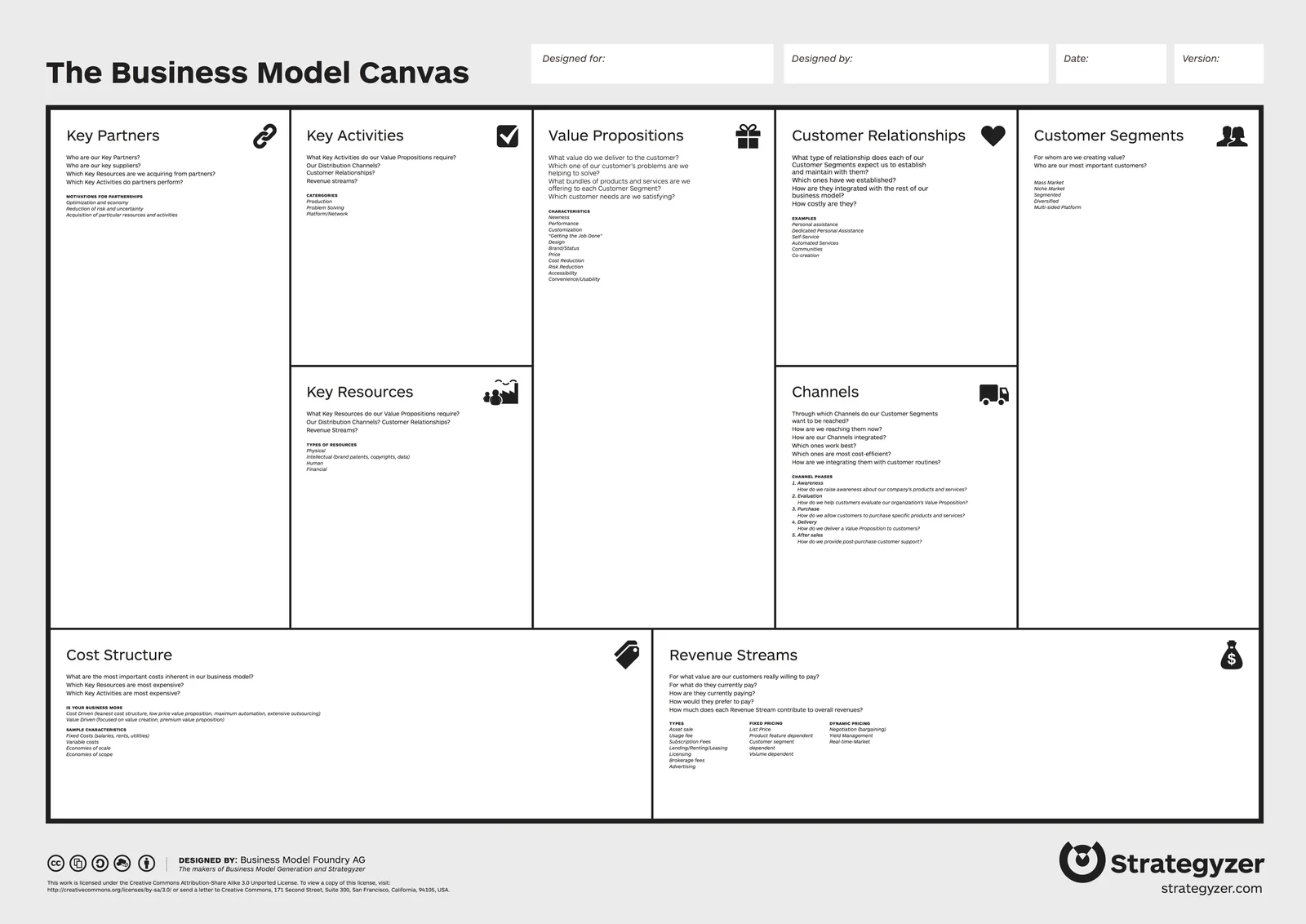
The Business Model Canvas is a one-page description of how an organisation intends to create, deliver and capture value. Its nine blocks cover the customers, the offer, the work and partners behind it, and the money flowing in and out. A completed canvas puts the whole argument in view at once. It is not evidence that the argument holds.
Use it to make a business model testable. Write specific entries, draw the links between blocks, mark which entries rest on evidence and which are guesses, then test the link most likely to break. A customer segment implies a value proposition, a channel and a relationship; serving it implies costs; revenue depends on what that segment will actually pay.
This guide follows one fictional example: a shared commercial kitchen that rents hourly kitchen time and storage to small food start-ups. Its people, conversations and decisions are invented to show the method.
Where the canvas comes from, and what it claims
The canvas grew out of Alexander Osterwalder’s doctoral research at the University of Lausanne, supervised by Yves Pigneur. His 2004 thesis aimed to provide the basis for a managerial tool that lets a firm express its business logic. Using a design-science approach, it proposed a business model ontology built on four pillars: product, customer interface, infrastructure and finance. The abstract reports validation through case studies and a panel of experts and managers.
Osterwalder and Pigneur developed that work into the practitioner book Business Model Generation, published by Wiley in 2010. The book’s published preview defines a business model as “the rationale of how an organization creates, delivers, and captures value”. It groups nine building blocks into four areas: customers, offer, infrastructure and financial viability.
Strategyzer publishes the canvas template with a short guide, and its advice is modest: one canvas per business model, treated as “a claim, not a plan”, dated and versioned as evidence arrives. Its usage terms say the Business Model Canvas was released under a Creative Commons licence, with the Strategyzer.com credit visible under every canvas, while the related Value Proposition Canvas is under more restrictive copyright. Check the current terms before reproducing either.
Academic writing on business models is less tidy than the template. Zott, Amit and Massa’s 2011 review found that scholars did not agree on what a business model is, although shared themes were emerging, including a system-level view of how firms do business. The canvas is one well-known way to describe that system, not the definitive one.
A fictional shared kitchen, block by block
Consider a fictional founder planning a shared commercial kitchen in a former bakery unit. Caterers, bakers and sauce makers would book licensed kitchen time by the hour and rent storage, without a lease or an industrial oven of their own. A kitchen manager with long restaurant experience has agreed to join if the project goes ahead. The landlord has offered a five-year lease, and the founder must decide within six weeks whether to sign it and order the fit-out.
The first canvas, drafted alone at a kitchen table, read: customer segments, “food start-ups”; value propositions, “affordable, flexible, high-quality kitchen space”; channels, “social media and word of mouth”; customer relationships, “a friendly community”; revenue streams, “hourly rental”; key resources, “kitchen and equipment”; key activities, “bookings and cleaning”; key partners, “landlord, equipment supplier”; cost structure, “rent, equipment, staff”.
Nothing there is exactly wrong, but it is too general to test. Who is a food start-up? Affordable compared with what? What does “flexible” mean to someone who bakes bread for cafés and must deliver by seven in the morning?
Strategyzer describes the right side of the canvas as the market and the left side as what it takes to serve it, with value propositions in between. Read that way, the draft makes one broad promise to an undefined group and hopes the money works out.
Reviewing it, the kitchen manager described three businesses she knew. A baker selling to cafés needs oven time before dawn, several days a week. A caterer needs plenty of space on Fridays and Saturdays and little midweek. A sauce maker needs occasional long bottling runs, plus dry and chilled storage in between. These are not variations on one customer. They are three candidate segments.
The links matter more than the boxes
Business Model Generation suggests treating customer groups as separate segments when their needs justify a distinct offer, when they are reached through different channels, need different relationships or differ substantially in profitability, or when they will pay for different aspects of the offer. The three tenant types meet several of those tests, and that affects every other block.
Each segment needs its own value proposition, channel and relationship. For the baker, the proposition is dependable pre-dawn oven time in an inspected kitchen, which could let a home baker take on wholesale orders. The channel might be a food-market organiser who knows who is outgrowing a home kitchen; the relationship, an induction and a standing weekly booking. For the sauce maker, the proposition is closer to secure storage with occasional production days. Work through each segment’s value proposition in more detail before assuming one offer fits all three.
Key activities, resources and partners drive the cost structure. The book notes that costs can be calculated relatively easily once key resources, activities and partnerships are defined. Pre-dawn baking means someone must open the building, check equipment and clean between sessions, or the kitchen needs a secure self-access system. Either route costs money, as do chilled storage and the extraction a busy kitchen needs. None of this was visible under “rent, equipment, staff”.
Revenue streams depend on willingness to pay, segment by segment. The book asks, “For what value is each Customer Segment truly willing to pay?” A baker may pay a premium for 4 a.m. access, or may be choosing a shared kitchen because it is cheap. A sauce maker might value storage above kitchen hours. Other blocks shape willingness to pay too: a kitchen manager who helps a new tenant prepare for a food-safety inspection is part of what that tenant buys.
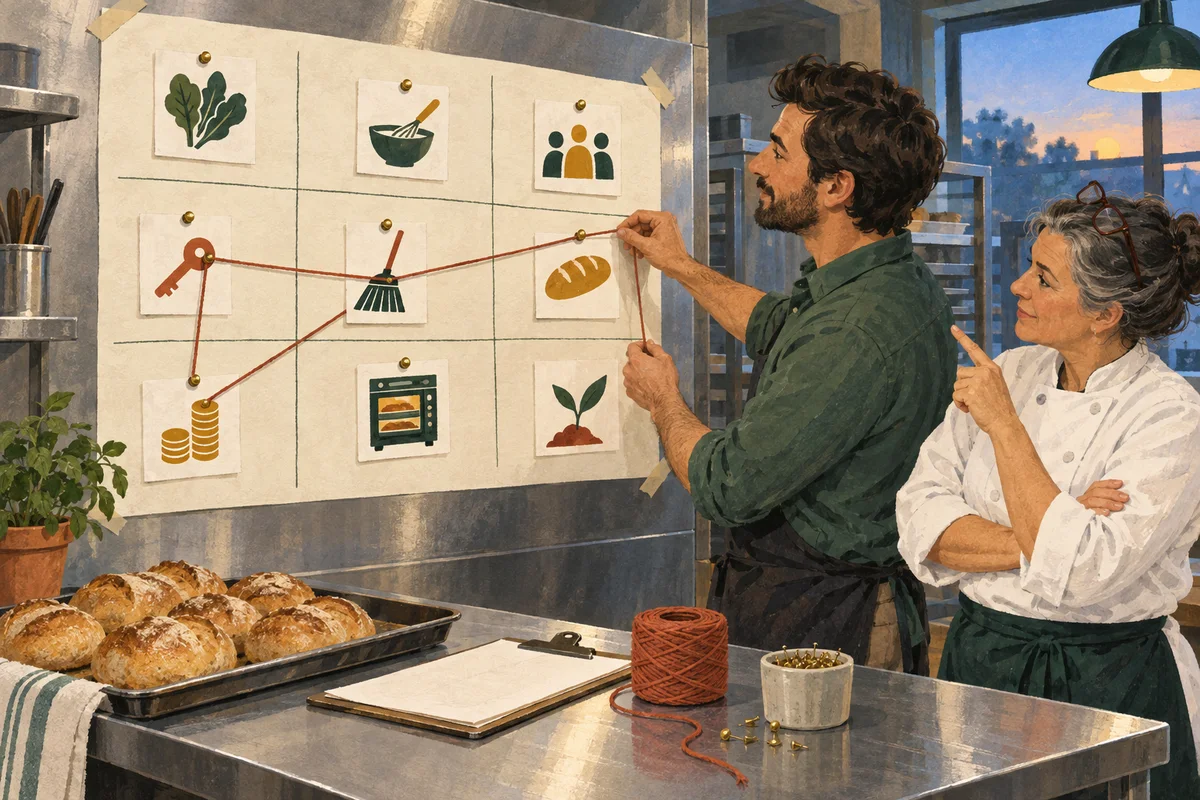
Teece’s analysis makes the general point that a business model’s elements must be designed with reference to each other. Strategyzer puts it practically: move a customer segment, and the channels, activities and costs have to move with it. Drawing lines between dependent entries turns the canvas from a list into an argument you can inspect.
A canvas is not a strategy or a business plan
Teece describes a business model as a conceptual rather than a financial model of a business. It is not a spreadsheet, although it may later be embedded in a business plan with income statements and cash-flow projections. He also argues that a business model is more generic than a business strategy, and that strategy analysis is needed because many business model features are easy to imitate.
For the kitchen, the canvas shows what the model is and how its parts depend on each other. A strategy asks why this kitchen should win bookings when a competitor could copy hourly rental next year. A business plan turns the chosen model into financial projections, a funding request and a timetable; built on untested canvas entries, it only makes the guesses look more precise. The book itself says a business model is “like a blueprint for a strategy” to be implemented through structures, processes and systems; it connects strategy and operations but replaces neither.
Our comparison of product, process and business-model innovation explains why the object of change shapes the evidence you need. Calling a new model “disruptive” does not test it either; the term has a specific meaning, set out in our comparison of disruptive and radical innovation.
Run a first working session
A first session can take about ninety minutes with three to six people who, between them, understand customers, operations and costs. That is a practical starting point, not a research-based rule. For the kitchen, the founder, the kitchen manager and one prospective tenant are enough for a first pass.
- Write the decision at the top: “Should we sign a five-year lease and fit out the unit?”
- Choose one customer segment. Use a separate canvas, or a distinct note colour, for each further segment.
- Write one specific statement per note: “oven available from 4 a.m. on weekdays”, not “flexible”.
- Start with the right-hand side, so customers stay in view before equipment lists take over.
- Draw the links you rely on. Every cost should trace back to an activity, resource or partner, and every revenue stream to a segment.
- Mark each note’s evidence status, as described below.
- Date the canvas and give it a version number before anyone photographs it.
If you have several competing models, draw a canvas for each and compare them without discarding the unfamiliar option too early.
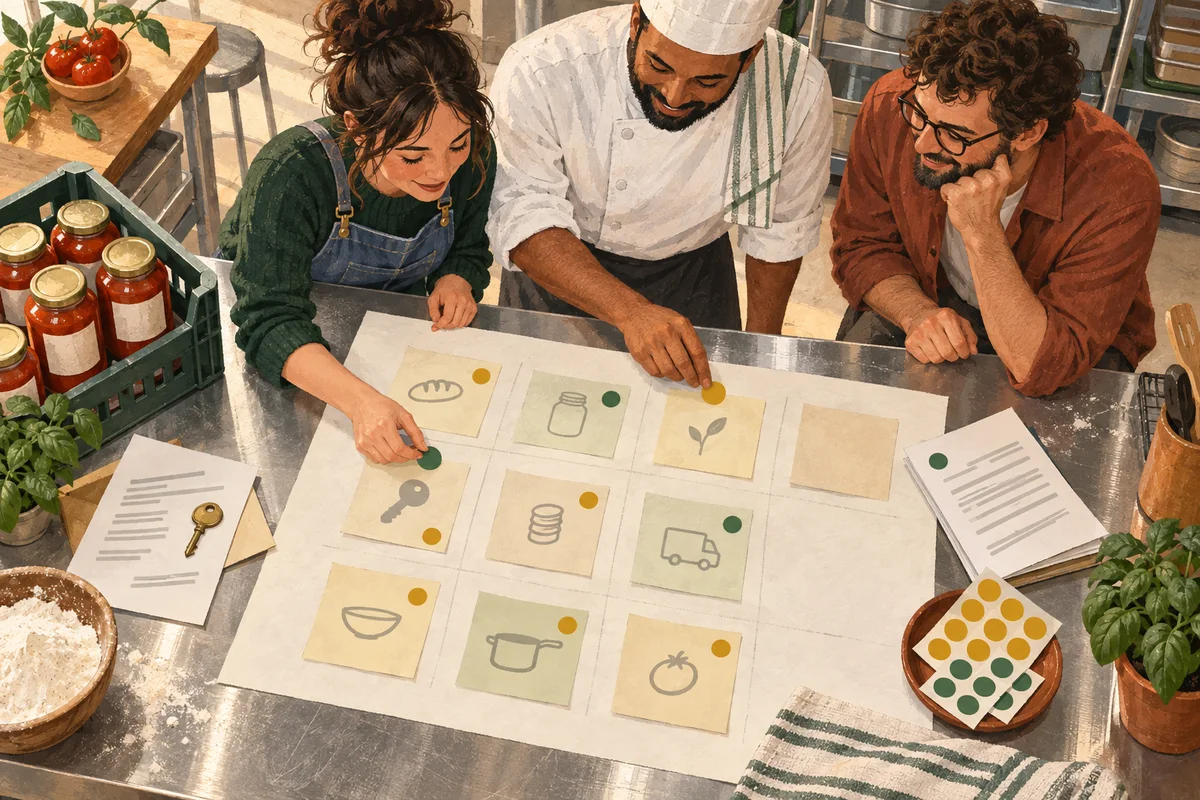
Mark each entry as evidence or assumption
Teece concludes that a business model reflects management’s hypothesis about what customers want, how they want it and what they will pay, and how the enterprise can organise to meet those needs and get paid. Designing one, he adds, means assembling evidence to validate conjectures and adjusting as it arrives. The canvas makes that hypothesis visible, note by note.
Give each entry one of five labels. Documented: a record exists, such as a supplier quote or draft lease terms. Observed: someone on the team saw it happen. Reported: someone told you, which is useful but weaker. Assumed: there is no support yet. Contradicted: the evidence points the other way. Note the source and date, because a baker’s schedule can change when she wins a new café contract.
The kitchen team’s second canvas focused on bakers and sauce makers. Everything in the table is fictional.
| Block | Example entry | Evidence status | Possible test |
|---|---|---|---|
| Customer segments | Bakers supplying cafés who need oven time before dawn | Reported by two bakers | Reconstruct each baker’s recent production weeks |
| Value propositions | Inspected oven time from 4 a.m., no lease needed | Assumed | Ask bakers to explain the offer and access rules back |
| Channels | Referrals from the food-market organiser | Assumed | Organiser shares an invitation; log enquiries |
| Customer relationships | Induction, then a standing weekly booking | Assumed | Run one trial induction |
| Revenue streams | Hourly fee plus a monthly storage charge | Partly contradicted: sauce makers asked about storage first | Take refundable deposits for a pilot month |
| Key resources | Deck oven, chilled storage, extraction | Documented: supplier quote | Confirm extraction needs with a qualified engineer |
| Key activities | Opening, cleaning between sessions, bookings | Assumed | Time a full changeover between two tenants |
| Key partners | Landlord leases the unit and approves alterations | Terms documented; incentives unknown | Ask what the landlord needs from the lease |
| Cost structure | Rent, early cover, cleaning, insurance, waste | Partly documented; early cover assumed | Price the cover needed for pre-dawn sessions |
The labels are deliberately blunt. “Reported by two bakers” is not “bakers want this”; it shows how thin the support is. A canvas full of “assumed” labels is not a failure but an honest starting point.
Trace the riskiest links
A model rarely fails because one box is wrong in isolation. It fails because a chain breaks. In the kitchen, one chain runs from the baker segment to pre-dawn access, to early-morning cover, to cost, and back to the price bakers will pay. If that price cannot cover someone opening the building at 4 a.m., the proposition, the activity and the cost line need rethinking together.
Write each important chain as one sentence: “Enough bakers will book weekday mornings at a price that covers early cover and cleaning.” Ask what would happen if it were wrong and what supports it. Assumption mapping places such statements by importance and evidence, so attention goes to consequential beliefs with little support.
A second chain runs through the key partner. The landlord wants a five-year commitment, while the founder’s demand evidence covers weeks, and the first canvas said nothing about what the landlord needs. Would a shorter first term work in exchange for a commitment on grease management and restoring the unit at the end? Make the partner’s reasons visible rather than assuming shared enthusiasm. A premortem can surface chains nobody has drawn: imagine the kitchen closed a year after opening and ask which link gave way.
The template itself can hide a link. Ash Maurya’s Lean Canvas, a practitioner adaptation for start-ups, replaces key partners, key activities, key resources and customer relationships with problem, solution, key metrics and unfair advantage. Maurya argues that pursuing key partnerships from day one can be a form of waste for an unknown start-up, while accepting that ventures with heavy capital and regulatory requirements may need partners first. The kitchen resembles that exception, because its riskiest link runs through the landlord. Whatever the template, keep that link on the page.
Test the link, then redraw the canvas
Match each test to the link, not to the most convenient activity. To understand bakers’ current workarounds, hold customer interviews that reconstruct a recent week of work instead of asking whether they would like a shared kitchen. To check that the offer and access rules make sense, run a small concept test. To learn whether people will pay and turn up, a first version designed for learning may be enough. For extraction and drainage, get a qualified quote; no workshop can settle that.
In the invented example, the founder arranged a four-week pilot in a restaurant kitchen that stands empty on Mondays and Tuesdays, with the owner’s agreement and refundable deposits from a handful of tenants. It was not a miniature of the full business. It tested whether tenants would pay and turn up for booked sessions, and what a changeover really involved.
Three entries moved. Sauce makers rarely booked kitchen time but kept asking whether they could leave stock between sessions, so storage looked like the core of their proposition. Changeovers took much longer than planned, because the kitchen manager would not hand over a bench until it had been cleaned and checked. Early-morning cover only looked affordable if baking sessions were grouped on fewer days.
The founder did not sign the lease as offered. He asked for a shorter first term with a break clause and offered to fund a grease-management contract, which met the landlord’s main worry. Version three of the canvas focused on bakers and sauce makers, whose hours rarely collide, grouped pre-dawn sessions on three weekdays and priced storage as a revenue stream in its own right. Caterers’ weekend demand moved to a separate, dated canvas. Funding followed the same logic: pay for the next question rather than the whole fit-out.
Mistakes that make a canvas look finished
- Generic words. “Quality”, “affordable”, “flexible” and “everyone” fit any business. Replace them with something a customer could confirm or contradict.
- One canvas for several segments. Strategyzer advises filling in a canvas for one business model, not a whole company. Mixing bakers and caterers on one sheet hides their different hours, channels and prices.
- Missing costs. Cleaning time, empty hours, insurance, waste collection and booking administration are easy to omit. Trace every activity and resource to a cost.
- Treating a filled canvas as validation. Strategyzer’s own page says a filled-in canvas isn’t a decision. Completeness shows that someone considered each block, not that customers agree.
- Ignoring partners’ incentives. The book notes that companies form partnerships to optimise a model, reduce risk or acquire resources. A partner named on the canvas is not a partner whose interests you understand.
- Undated versions. Without a date and version number, nobody can tell which canvas reflects the latest evidence, and discarded guesses quietly return as facts.
Limitations and evidence behind the canvas
The canvas has an academic origin: a doctoral thesis that built a business model ontology and evaluated it with case studies and expert review. As the abstract describes it, that evaluation concerned the ontology itself; it does not show that teams using the canvas decide better or build more successful businesses, and this guide makes no such claim. Usage figures on a vendor’s site are marketing claims, not evidence of how well a tool works.
With no agreed definition of a business model, any nine-block template embodies choices about what to include. Teece argues that a business model needs strategy analysis before it can be defensible. A canvas says little about competitors, timing, regulation, team capability or financing, and one page can make a complicated operation look simple.
Use the canvas for a shared, inspectable picture of how a model is meant to work and where it is exposed, not as a feasibility study, a financial model or proof of demand. Food safety, insurance, planning and lease terms need qualified advice. The kitchen and its pilot are invented; the habit they illustrate is not. Write the model down specifically, mark what you know, test the weakest link, and redraw the canvas with a new date.
Sources:
- Alexander Osterwalder (2004). The business model ontology: a proposition in a design science approach.
- Alexander Osterwalder and Yves Pigneur (2010). Business Model Generation (published book preview).
- Strategyzer (n.d.). The Business Model Canvas.
- Strategyzer (n.d.). Usage of our tools.
- David J. Teece (2010). Business models, business strategy and innovation.
- Christoph Zott, Raphael Amit and Lorenzo Massa (2011). The business model: recent developments and future research.
- Ash Maurya (2015). Why Lean Canvas vs Business Model Canvas?.