In this guide
- 01Name the unwanted result
- 02Generate ways to cause it
- 03Reverse into options
- 04Choose a test
Reverse brainstorming develops possible improvements by first asking how to make a specific problem worse. The group invents actions or conditions that would undermine the desired outcome, examines the mechanisms behind them, and translates selected mechanisms into responses worth investigating.
The translation is the important part. “Make every customer wait” does not yield a useful design when changed into “make nobody wait”. Ask what creates the waiting, what the team can change and what might happen when it does. The output should be a small set of candidate responses, with evidence gaps and a next step.
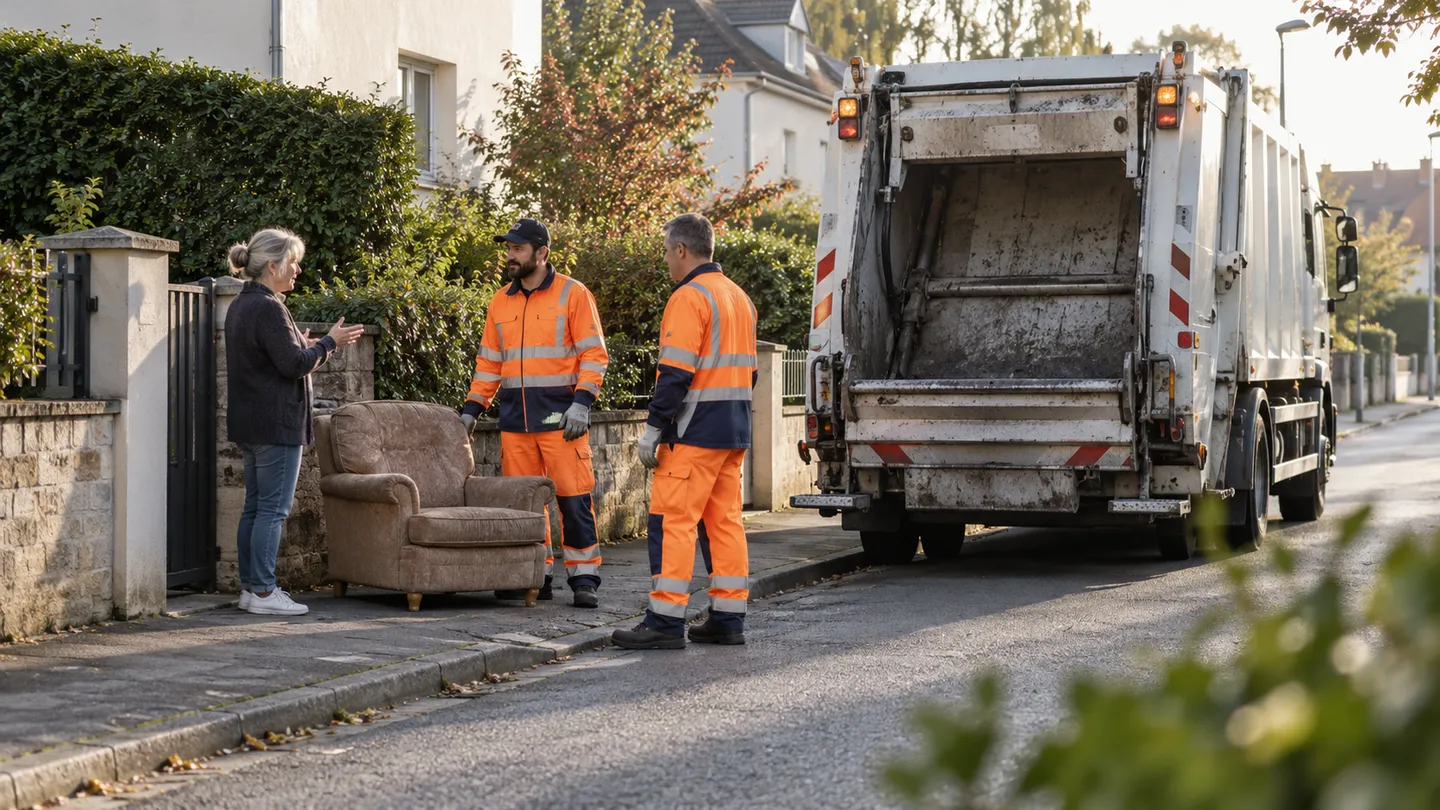
This guide follows a fictional municipal bulky-waste collection service. Residents sometimes prepare furniture for a booked pickup, but the crew cannot find or reach it. The service team has repeatedly proposed reminders. It wants to explore other causes and responses before adding another message. Every detail of the case is hypothetical.
Choose a problem with a clear desired outcome
Write the positive task first: “Help residents and crews complete a booked bulky-item collection without an avoidable missed pickup.” Include the people, situation and boundary. The session covers booking through collection; it does not redesign the municipality’s entire waste policy.
Then reverse the outcome: “How could we make a booked pickup reliably fail, even when the resident and crew both intend it to succeed?” This formulation directs attention towards arrangements, rather than the character of residents or workers.
The Open University Business School’s description uses opposite-outcome questions to explain the method. Durham University’s teaching guidance similarly describes considering negative impacts and challenging assumptions. These are accounts of the technique, not proof that the resulting remedies work.
If the problem rests only on internal impressions, investigate recent incidents first. Customer interviews can reconstruct how a resident arranged their last collection. A journey map can expose a gap between booking instructions and preparing an item. Bring those observations into the session without treating one account as the whole population.
Distinguish reversal from a premortem
A premortem begins with a proposed plan and an imagined future failure, then asks what caused it. Gary Klein’s own description establishes that future-looking-back approach. Use it when a sufficiently concrete proposal needs scrutiny before commitment.
Reverse brainstorming can happen earlier. The collection team has a recurring problem but has not selected a new service design. Its reversed prompt deliberately invents ways to undermine successful collection. It is generating possible mechanisms and responses rather than testing the vulnerabilities of one chosen plan.
The methods can produce overlapping concerns. That does not make them interchangeable. Choose according to the question: widen responses to a current problem, or inspect a particular future commitment. The ideation-method comparison helps make that choice before designing the agenda.
Do not use a reversed question to hide a decision already made. If new reminders have been approved and the only available choice is their wording, tell participants that. They should not believe the whole service remains open to redesign.
Invite people who know different parts of the failure
Include a booking adviser, a collection worker, an operations coordinator and people who understand resident access needs. Invite residents directly where participation is appropriate; otherwise bring verified accounts and name whose experience remains missing.
Set the boundary for the negative phase. Describe processes, dependencies and information. Avoid naming individuals, inventing humiliating behaviour or recording identifiable complaints where the workshop does not need them. A darkly amusing prompt can quickly become permission to stereotype absent people.
Edmondson’s research on psychological safety found an association with team learning behaviour in a manufacturing setting. It does not show that calling an activity playful makes criticism safe. Discuss the conditions for speaking up, including how a sponsor will respond to a concern about current practice.
For a first session, a practical plan is ten minutes to frame, ten to write, fifteen to clarify, twenty to translate and fifteen to choose follow-up. These are editorial starting timings. Allow additional preparation and extend the translation stage when mechanisms need more work.
Invent ways to make the problem worse
Start with private writing so the first confident speaker does not supply the whole list. Use one action or condition per contribution. Participants can speak or dictate instead where writing is a barrier. Our brainwriting guide gives a fuller written-exchange format if that would help the group build on ideas.
In the fictional service, contributions include hiding the item behind a locked gate, giving residents and crews different pickup locations, treating every item as eligible until the truck arrives, and making changes impossible once the booking is submitted.

Keep contributions specific enough to examine. “Be inefficient” is a verdict. “Require the resident to telephone a different team to amend the item list, without transferring the booking reference” describes an arrangement that could create a failure.
During this phase, defer feasibility judgments. The purpose is to develop candidate mechanisms, including exaggerated ones. Deferring judgment does not mean tolerating insults or continuing when someone identifies an immediate real-world concern that requires attention.
If the list becomes a series of jokes, return to the sequence of work. What information is missing at booking? What must happen before the truck leaves? What can the resident reasonably arrange? These prompts bring the exercise back to service design.
Clarify the mechanism before reversing the wording
Read the contributions aloud, invite correction and group only those with the same causal pathway. A hidden item and an ineligible item both create a missed pickup, but through different mechanisms. One involves location and access; the other involves eligibility and preparation.
Add an evidence label to each: observed in a specific incident, reported by somebody, internally assumed, or invented for the exercise. Do not use a vote to change a label. Several people agreeing that “this happens all the time” still leaves a claim needing records or investigation.
GOV.UK’s research-analysis guidance distinguishes observations from findings and actions. Apply that discipline carefully: workshop inventions are a separate input, not observations. Write what happened in an actual incident separately from the team’s explanation.
For example, a crew report might establish that a gate was locked. It may not establish why. A resident might have believed they needed to protect the item from rain, have misunderstood the accessible location, or be unable to move it alone. Each explanation suggests a different response.
Turn each reversal into a mechanism
Use three questions: what condition enables the bad outcome, what intervention could change that condition, and what other outcome could the intervention create? This prevents the translation from stopping at a slogan.

The table below is an original worksheet for the fictional service. Its entries are proposals, rather than established findings or recommendations for a real municipality.
| Worsening idea | Mechanism to examine | Candidate response | Important check |
|---|---|---|---|
| Hide the item behind a locked gate | Crew and resident assume different accessible locations | Confirm the collection point using a plain description or picture | Does the resident have a safe, workable way to place it there? |
| Accept any item at booking | Eligibility is only checked after travel | Explain relevant limits before accepting the booking | Can people understand the limits without specialist vocabulary? |
| Make amendments impossible | Booking details cannot reflect a changed situation | Offer one amendment route linked to the reference | Who receives changes before the route is finalised? |
| Tell the crew only an address | The crew lacks the item and location details | Give both parties the same confirmed collection details | What information is genuinely necessary? |
Notice the difference between a response and a mechanism. “More reminders” is a channel choice. A shared collection location addresses a coordination problem. It might require a clearer instruction, an adviser conversation or assistance with preparation. The method should keep those alternatives open.
Avoid creating a fresh burden to solve an old one. Requiring every resident to upload a photograph may help a crew in some cases while excluding people without a suitable device. Consider a supported route instead of assuming every person can complete the new step.
Choose what to investigate first
Use idea evaluation to distinguish non-negotiable conditions, probable benefits and missing evidence. Keep early judgments coarse. A speculative label such as “high impact” should prompt a question about the mechanism, rather than certify the option.
In the example, the team first explores location confirmation because it connects several plausible failure pathways and can be examined without changing the whole routing system. That is an illustrative choice, not a universal priority for collection services.
Assumption mapping makes the consequential belief explicit: residents and crews can use the same location description, and residents can act on it. The team plans a bounded experiment to observe preparation and handover in a small set of agreed situations.
The route from adviser to crew also deserves attention. A service blueprint can show who confirms a change, where the information is stored and what reaches the crew. Without that internal handoff, clearer customer instructions may improve expectations while leaving delivery unchanged.
Close with a translation and decision record
Keep the reversed prompt, contribution references, evidence labels, translated options and reasons for selecting or deferring them. Assign an owner to each open check and state when the team will review the finding.
The useful closing statement is specific: “The booking coordinator will rehearse location confirmation with residents and a crew representative, including an assisted-preparation situation, before proposing a trial.” “We agreed to improve communication” gives no comparable direction.
If the exercise sits inside a broader workshop, preserve time for this closing work. The 90-minute idea-workshop agenda connects generation, development and a next test. A negative phase is useful only if the meeting gives its output somewhere to go.
Return the findings to participants, including those whose suggestions were deferred. Explain what changed and what remains unresolved. This makes contribution consequential without promising that every idea will be implemented.
Evidence and limitations of reversal
The opened sources describe the method and related disciplines; they do not establish a general performance advantage over other ideation formats. The agenda, translation questions, collection example and worksheet are original practical guidance.
Reversal may reproduce the group’s existing explanations, overemphasise vivid failures or produce remedies that ignore external constraints. It cannot estimate how often a failure occurs or establish that an intervention will prevent it. Follow important mechanisms into research and testing.
Use the method when a familiar discussion needs a different route into the problem. If the group already understands the defect and can responsibly repair it, organise that work directly. If it leaves with a sharper question and an accountable investigation, the reversal has produced a useful result even before any service change is approved.
Sources:
- The Open University Business School (2023). Top tips for decision-making in business (Part 2).
- Durham University DCAD (n.d.). Brainstorming.
- Gary Klein (n.d.). Premortem: Method of Risk Assessment.
- Amy Edmondson (1999). Psychological Safety and Learning Behavior in Work Teams.
- Government Digital Service (n.d.). Analyse a research session.