In this guide
- 01Agree a shared question
- 02Explore in small groups
- 03Share understanding
- 04Reflect on what changed
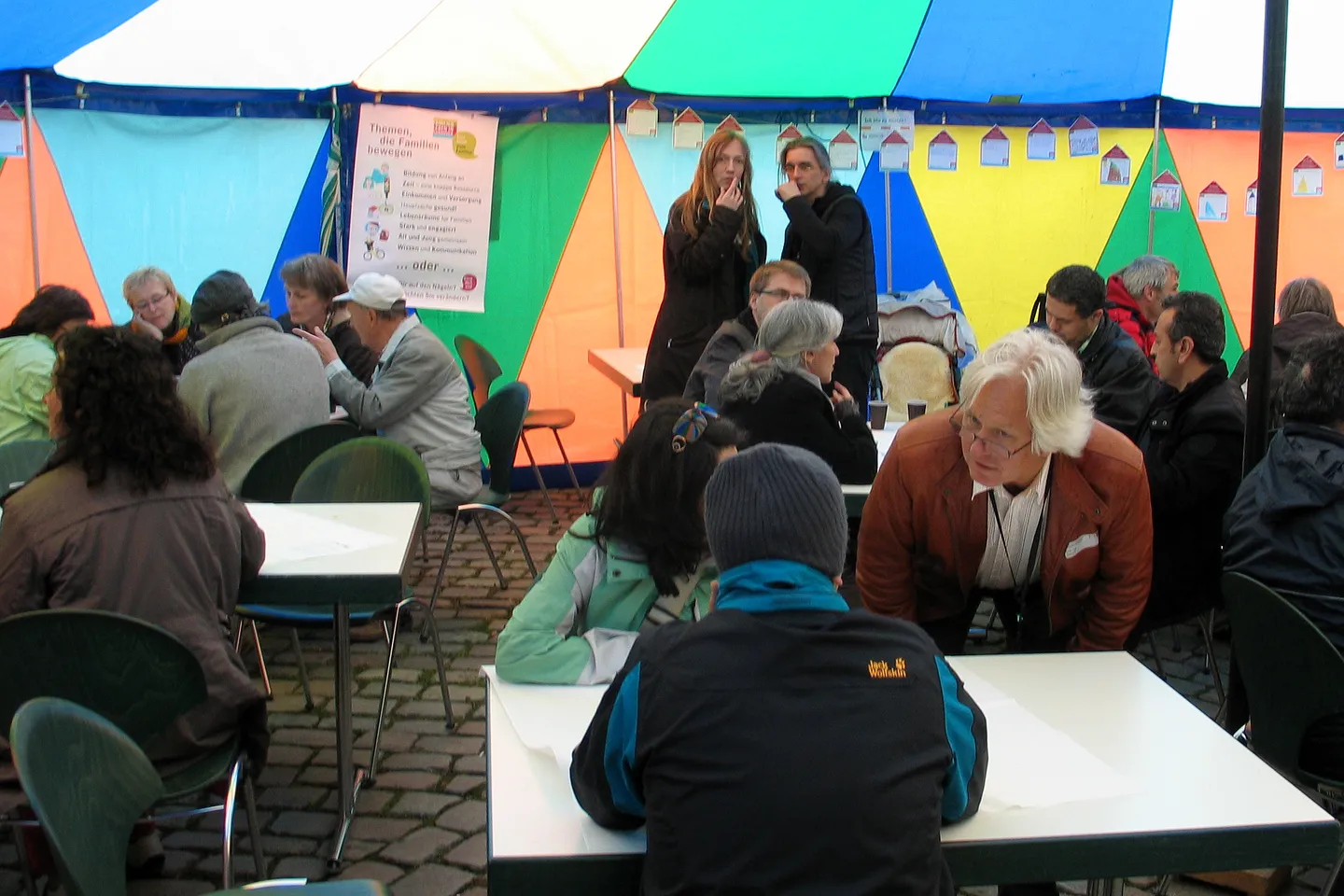
A Knowledge Café brings people together around an open question to explore different understandings of an issue. In the Gurteen format, participants talk in small groups and then continue the conversation together. The intended value is deeper understanding and useful insight; an agreed action plan is not a necessary output of every session.
Use it when people experience the same work differently and need to examine those differences before prescribing a solution. It is less suitable when the room needs to approve a proposal, investigate an individual complaint or make an urgent operational decision. Conversation can inform those processes, but it cannot supply their authority or safeguards.
This guide explains the Gurteen Knowledge Café and offers an original 100-minute workplace adaptation. The worked housing-service case is hypothetical. It is a preparation aid, not evidence that the format produces agreement or prevents conflict.
Understand the format’s purpose
David Gurteen’s Knowledge Café tipsheet, based on an earlier tipsheet by Steve O’Hagan, emphasises open dialogue, small groups, movement between conversations and a whole-group circle. Its suggested duration and group size are practitioner starting points, not empirically validated limits.
The emphasis is exploring meaning together. Participants can question a familiar term, connect a colleague’s experience with their own or recognise an assumption they had not noticed. A disagreement can therefore be a useful outcome if the group understands what it concerns more clearly.
The facilitator protects the conditions and timing while avoiding control of the substantive answer. Participants need permission to listen, question and change their view. They do not need to perform enthusiasm or arrive at the answer the sponsor privately prefers.
Before choosing the method, write what the session will contribute. “Understand what colleagues mean by keeping a resident informed” is an appropriate inquiry. “Secure support for the new policy” makes open exploration doubtful if the conclusion has already been set. Use change contracting to clarify the sponsor’s expectations.
Choose between Knowledge Café, Lean Coffee and World Café
These formats can all support conversation, but their organising choices differ. Choose the structure for the work the participants need to do.
| Format | What organises the conversation? | Typical emphasis |
|---|---|---|
| Knowledge Café | A shared open question, followed by small-group and whole-group dialogue | Explore meaning and develop understanding |
| Lean Coffee | Participants propose and prioritise topics in a visible queue | Spend discussion time on the group’s chosen questions |
| World Café | Designed rounds with table conversations, movement and a harvest | Connect perspectives across groups and make emerging insights visible |
The Lean Coffee originators describe participant-created topics, voting and a simple board. If people need to bring several different questions, our Lean Coffee guide explains that participant-led structure.
The World Café Foundation’s method describes designed questions, successive rounds and a harvest, often represented visually. Our World Café guide helps when connecting and capturing those contributions is central. A Knowledge Café typically keeps more attention on the conversation itself and uses a shared dialogue at the end rather than a table-reporting sequence.
These are distinctions in emphasis, not absolute rules. Adaptations exist. State the chosen process so that participants know whether they are exploring one question, prioritising topics or contributing to a documented harvest.
Choose a question that invites exploration
Consider a hypothetical housing-service organisation in which call handlers, repairs coordinators and maintenance colleagues discuss resident updates. All three groups use the phrase “keep the resident informed”, but each may mean a different moment, channel or level of detail.
An inviting question is: “What does a useful resident update need to do when we do not yet know the repair date?” It specifies a practical situation while leaving room for several interpretations. “How do we get maintenance to send better updates?” embeds a diagnosis and a blamed group in the invitation.
Test the question with people from different roles. Can each bring a relevant experience? Is the issue important enough for sustained exploration? Does the wording allow someone to disagree with the assumption behind it? The systemic-questions guide offers ways to examine perspectives and relationships without turning the conversation into an interrogation.

Give a short context statement, including what is already known and what remains uncertain. If a policy requires a particular notification, state that boundary. The café can explore how people understand and deliver it; it cannot suspend the requirement.
Do not overload the opening with a long presentation. One concrete situation is enough to begin. Participants should spend most of the time talking with one another, rather than listening to the sponsor explain the preferred solution.
Prepare participation and the room
Invite colleagues with different experiences of the question, including part-time or less visible roles. Use stakeholder mapping to identify whose perspective might otherwise be absent. A café of managers discussing frontline work has a clear participation limitation, however engaged the conversation becomes.
For the hypothetical session, invite 20 people across the three work areas and arrange four tables of five. These numbers belong to the example. Provide an accessible layout, a way to hear one another and a method for moving between groups that does not require everybody to change seats physically.
Explain confidentiality and documentation in advance. Use invented or sufficiently anonymised examples of resident situations. Do not record audio by default or promise complete confidentiality in a room where the facilitator cannot control later retelling. Agree what a sponsor will receive afterwards.
Edmondson’s team-learning study reports an association between psychological safety and learning behaviour in work teams. It does not establish that a café format creates safety. Our psychological-safety guide explains why the consequences of speaking matter alongside the invitation to speak.
If a participant fears that disagreement will affect their employment, a conversational etiquette reminder is insufficient. Consider another route for input, a different group composition or postponing the café until the issue can be addressed. Participation should not require disclosure of a personal concern.
A 100-minute facilitation plan
Gurteen’s public-café procedure distinguishes sponsor, host, speaker and participants and provides an approximate two-hour event process. The schedule below is a shorter original workplace adaptation, including time for the question, changes of group and a modest close.
| Time | Activity | Facilitator’s purpose |
|---|---|---|
| 0–10 minutes | Welcome and agree the purpose and boundaries | Explain dialogue, confidentiality and the use of notes |
| 10–20 minutes | Introduce the situation and open question | Give enough context and check the question’s meaning |
| 20–65 minutes | Three short conversations in changing groups | Include transitions within the 45 minutes; keep listening central |
| 65–90 minutes | Whole-group conversation | Connect interpretations and unresolved differences |
| 90–100 minutes | Individual reflection and close | Invite an optional insight and explain any agreed follow-up |
For each small-group round, allow roughly 14 minutes of conversation and one minute for transition. Keep the same open question so that a new group can deepen the inquiry. Participants may bring an insight from their earlier conversation, but should not act as official representatives of a previous table.
Explain that tables do not need a chair, a minute-taker or a presentation. Personal notes can help someone remember a thought, but do not require continuous documentation. If an organisational record is essential, discuss a separate, agreed way to capture it without making every participant responsible for transcribing.
Move gently between groups to listen and notice process problems. Intervene if the conversation becomes personal criticism, if one voice dominates or if the group needs the question clarified. Avoid redirecting an unexpected interpretation merely because it makes the sponsor uncomfortable.
Bring the room together without turning it into a reporting contest
Move into a circle or another arrangement in which participants can address one another. Begin with a specific invitation: “What became clearer or more complicated as you heard other perspectives?” Let participants connect contributions across the room, rather than requiring each table to deliver three conclusions.

In the hypothetical housing service, a call handler says a resident update is useful if it gives a believable next contact time. A maintenance colleague says an update without a confirmed date feels misleading. A coordinator identifies a third possibility: explain what is known, what is waiting and when another update will occur.
The facilitator asks what distinguishes a promised repair date from a promised update. The group can now explore an assumption that was hidden inside its shared phrase. It has not yet established which arrangement works for residents, what the organisation can deliver or who should authorise a change.
When someone presents a view as universal, ask for the situation in which it applies. When two accounts conflict, keep both visible and ask which conditions differ. If the conversation keeps returning to an unquestioned target, the double-loop learning comparison can help frame a later inquiry into that governing assumption.
Tolerate a pause. The first person to speak should not have to invent a conclusion for the room. A facilitator’s short restatement can clarify a contribution, but repeated summaries can make everybody speak to the facilitator instead of to each other.
Follow up in proportion to what the café produced
Invite participants to identify an insight or a question they want to carry into their own work. Keep an action optional unless the group separately agrees one within its authority. Reflection can be worthwhile without creating another task list.
If the hypothetical housing service agrees to investigate the usefulness of update messages, identify who will do that work and which question remains open. The research-design guide can help turn the insight into an inquiry with residents. Colleague conversation is not a substitute for evidence from the people receiving the service.
Share a short, agreed note containing the question, participation boundary, important distinctions and unresolved matters. Do not describe it as the organisation’s consensus unless a suitable decision process actually established one. Allow people to correct a summary that misrepresents what was said.
A later change story may use the distinction between a repair date and an update commitment, once the responsible team has decided the arrangement. Keep the café’s contribution visible as insight, rather than claiming it approved the policy. Where colleagues need to pass practical know-how between roles, use a separate knowledge-transfer process.
Evidence and limitations
The primary sources describe the formats and their intended purposes. The psychological-safety study supports a related account of team learning, not the effectiveness of Knowledge Cafés specifically. The timings, housing example and follow-up record here are original adaptations; they do not predict a session’s outcome.
An articulate group can still miss absent perspectives, repeat inaccurate memories or mistake shared language for shared understanding. Keep important factual claims open to verification and involve people outside the room when their experience matters.
Use the format when conversation itself serves the inquiry. Set a clear question, protect listening, make the whole-group phase a continuing dialogue and preserve the boundary between what people explored and what an accountable process later decides.
Sources:
- David Gurteen, based on a tipsheet by Steve O'Hagan (n.d.). The Gurteen Knowledge Café tipsheet, version 1.10 EN.
- David Gurteen (n.d.). Public Café Procedure.
- Lean Coffee (n.d.). Lean Coffee: origin and format.
- The World Café Community Foundation (n.d.). World Cafe Method.
- Amy Edmondson (1999). Psychological Safety and Learning Behavior in Work Teams.