In this guide
- 01Capability gap
- 02Partner contribution
- 03Agreed boundaries
- 04Transfer and review
Open innovation involves deliberately using knowledge across organisational boundaries as part of developing and putting ideas to work. A business may bring external knowledge in, make internal knowledge available through an outside route, or develop something jointly with partners. The important question is not how many organisations attend the launch event. It is what each contribution makes possible and how it will be used.
For a company facing an unfamiliar materials problem, collaboration may be more sensible than trying to build every capability internally. But access to expertise is only a beginning. The company still needs to define the problem, assess the contribution and turn learning into dependable work.
Start with a capability gap, not a fashionable format
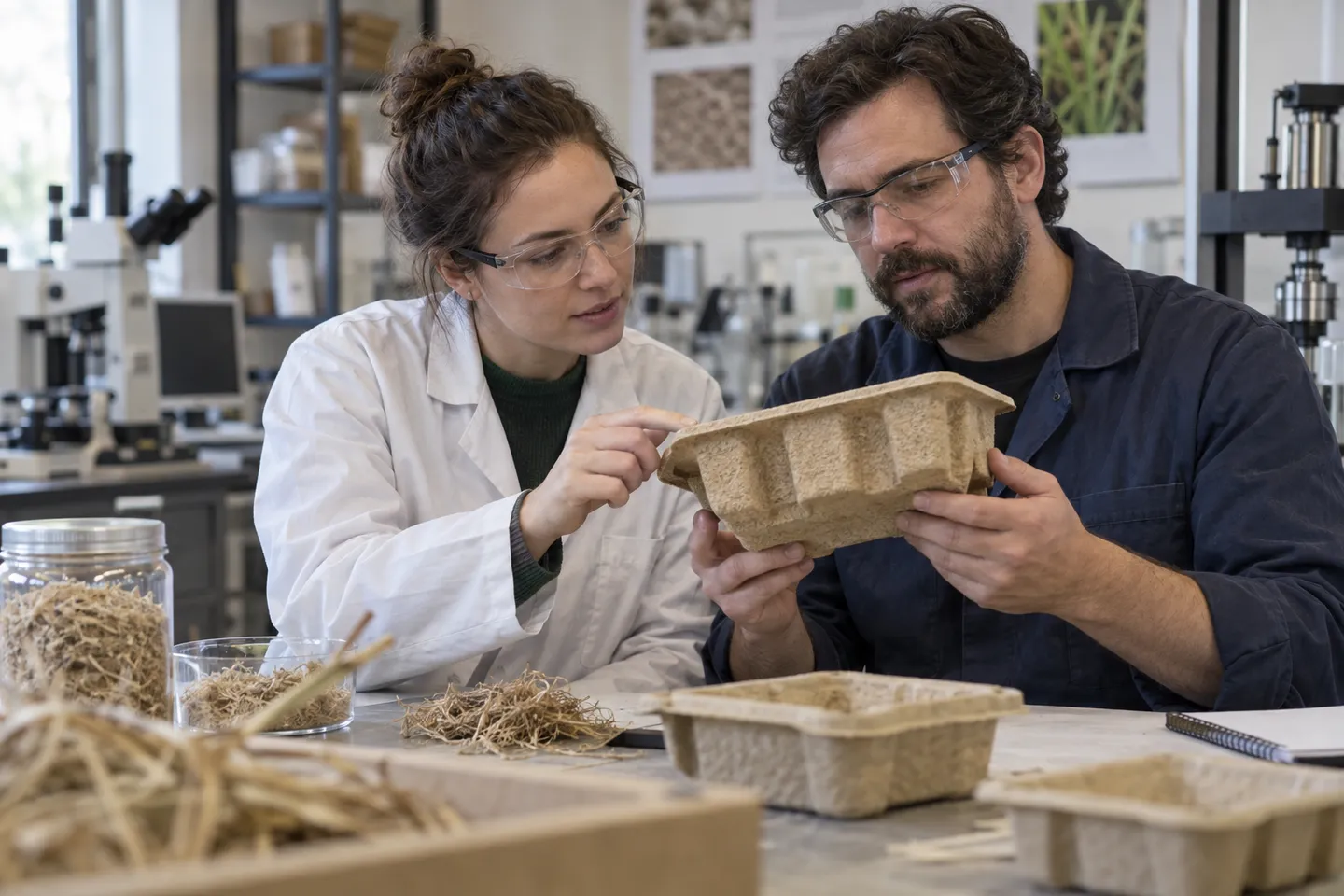
Consider a fictional packaging company exploring a fibre insert for reusable delivery boxes. Its staff understand packing operations and customer complaints, but they lack the materials expertise needed to evaluate a proposed fibre composition. A university group has relevant knowledge, while a delivery operator understands handling conditions.
A challenge competition, research partnership or supplier collaboration could each be considered. Do not choose the format before understanding the gap. If the problem is already well specified and an established supplier can meet it, an ordinary procurement relationship may be sufficient.
UC Berkeley Haas’s open-innovation programme places cross-boundary knowledge and collaboration at the centre of its approach. The practical distinction is that useful ideas and routes to application need not all originate inside one firm. This does not mean that every activity must be public or that all knowledge should be shared.
Define the intended outcome in terms of a decision: “We need evidence about whether this material approach deserves a controlled packaging trial.” That is clearer than “We want to build an innovation ecosystem.”
Distinguish three directions of knowledge flow
Outside-in work brings external knowledge into the organisation. For the packaging company, that could mean learning from materials researchers or incorporating a partner’s tested manufacturing method. The internal team needs enough understanding to evaluate and apply what it receives.
Inside-out work finds an external route for knowledge the organisation holds. A company might make a technology available to another firm that has a more suitable market or production capability. This does not automatically mean giving it away; the arrangement and rights require explicit agreement.
Joint or coupled work combines contributions through collaboration. In our example, researchers, packaging engineers and delivery staff might investigate material behaviour and handling together. The resulting work depends on complementary knowledge rather than a simple transfer of a finished answer.
These are useful directions, not rigid organisational types. A collaboration can move between them. Nor should “open” be confused with open-source licensing. Sharing selected knowledge with a partner and publishing material for broad reuse are different decisions.

Write a problem brief that a partner can assess
Explain the situation, what is already known, the uncertainty, relevant constraints and the decision the work will support. Share enough information for a potential partner to judge fit without exposing unnecessary confidential or personal material.
For the fictional packaging project, describe the product class, handling context, reuse ambition and existing limitations. Avoid prescribing a material solution in so much detail that a partner cannot question it. Equally, do not send a vague invitation to “transform packaging” and expect meaningful proposals.
Name the evidence needed. A sample that looks attractive is not the same as a material assessment, a repeatable production method or a workable return process. Clarify which contribution is being sought and which questions remain outside the collaboration.
Use stakeholder mapping to include people affected by the work. The delivery operator may expose handling conditions the laboratory does not see. The person who will inspect returned boxes may identify a problem that neither the researcher nor the designer anticipated.
Make the partner’s reasons visible
Ask what each participant needs from the arrangement. A research group may value a clear research question and an appropriate publication route. A supplier may want a viable commercial relationship. A delivery operator may want fewer handling problems without taking on unplanned work.
Do not assume that a shared interest in innovation means aligned incentives. Differences in timing, evidence standards and commercial expectations can be manageable when discussed early. Hidden differences are more likely to surface as frustration later.
The Cambridge Institute for Manufacturing’s implementation report draws attention to organisational culture and implementation challenges in large companies. Its findings do not establish that every partnership will succeed, but they underline that opening a boundary also creates internal work.
For our small project, appoint one operational contact on each side and a decision owner inside the company. Distinguish the person coordinating meetings from the person able to approve changes, resources or a next trial.
Agree the boundaries before exchanging sensitive work
Clarify the practical topics that require agreement: what each party brings, what may be shared, how outputs may be used, who can disclose results, how costs are handled and what happens if the collaboration ends. Existing knowledge and newly created outputs may need different treatment.
These are issues to take to qualified legal and commercial advisers, not a substitute contract supplied by a workshop. Requirements depend on jurisdiction, the parties and the material involved. Do not assume that a nondisclosure agreement answers questions of ownership, licensing or publication.
Strategyzer’s Business Model Canvas can help connect a partner’s contribution with activities, resources, costs and the customer offer. Use that connection to test whether the arrangement is commercially coherent, while leaving legal interpretation to the appropriate specialists.
A useful operational boundary might say that the first phase produces samples and an evidence note for internal evaluation, not a public claim that a new package is ready for customers. Make that distinction visible in communications as well as in formal agreements.
Plan how knowledge will become usable inside
A partner’s presentation may be understandable without being sufficient for someone else to perform the work. Plan demonstrations, documentation, practice and follow-up questions. Include the people who will own the process after the collaboration.
In the packaging example, an internal technician should be able to explain the relevant preparation conditions, recognise important variations and know when to seek specialist help. The aim is not to make that person a materials scientist overnight. It is to establish a realistic internal capability and its boundaries.
Our knowledge-transfer guide provides a practical starting point. Ask the receiving team to try the work under suitable supervision and record where instructions or assumptions remain unclear. A successful transfer is more than a file arriving in a shared folder.

Use a bounded first collaboration
Keep the initial commitment proportionate to the uncertainty. The fictional team can agree a small investigation with a review before wider trials. Define what will be observed, what outputs are expected and which findings could change the direction.
GOV.UK’s alpha guidance supports focusing early work on consequential assumptions. Applied here, the collaboration should investigate the limiting uncertainty, not build an impressive demonstration that avoids it.
| Collaboration element | Fictional packaging example |
|---|---|
| Company contribution | Packing context, samples and an internal technical owner |
| Research contribution | Materials expertise and interpretation within agreed scope |
| Operator contribution | Relevant handling situations and practical constraints |
| First output | Documented sample assessment and unresolved questions |
| Internal learning | Supervised reproduction of the agreed preparation process |
| Review decision | Revise, stop or plan a controlled trial with appropriate expertise |
The table is an original planning example, not a standard partnership structure. Actual responsibilities should reflect capability, authority and agreed terms.
Review usefulness, not just activity
At the review, ask what became clearer, what can now be done internally and what still depends on the partner. Compare the evidence with the initial question. Meeting attendance, signed agreements and prototype photographs are not enough to demonstrate useful progress.
If the material looks promising but the preparation process cannot be reproduced, the next step may concern transfer rather than more sample variety. If the operator identifies unacceptable handling constraints, the team may revise the concept or stop. Preserve that learning instead of calling the collaboration a failure simply because it did not reach launch.
Open innovation has limitations: coordination costs, unequal bargaining power, incompatible incentives, dependence on external expertise and difficulty absorbing knowledge. It is not inherently better than internal development, and more partners can increase complexity without adding useful capability.
The strongest conclusion is practical and modest: choose the boundary to open because the problem requires it, make the contribution and conditions explicit, and ensure someone inside can use what is learned. That is how collaboration becomes part of innovation work rather than an event beside it.
Sources:
- UC Berkeley Haas (n.d.). Open Innovation.
- University of Cambridge Institute for Manufacturing (n.d.). How to implement open innovation: lessons from studying large multinational companies.
- Strategyzer (n.d.). The Business Model Canvas.
- GOV.UK (n.d.). How the alpha phase works.