In this guide
- 01Agree the observation
- 02Watch a real task
- 03Separate notes and interpretation
- 04Review with participants
Observation research records what people do during a defined activity and in a stated setting. It can reveal sequence, interruptions, tools, workarounds and help that an interview account leaves unclear. It does not directly reveal what somebody thinks or why they acted.
Plan the question, participation arrangements and recording before the visit. During the activity, distinguish visible events from explanations. Afterwards, compare the evidence, examine contrary cases and decide which finding needs a change or another investigation.
The continuous example is a hypothetical public library studying borrowing at a self-checkout. The task sequence, notes and decisions are invented. The method is observational inquiry into a service, not a covert evaluation of visitors or staff.
Choose a task and an observation boundary
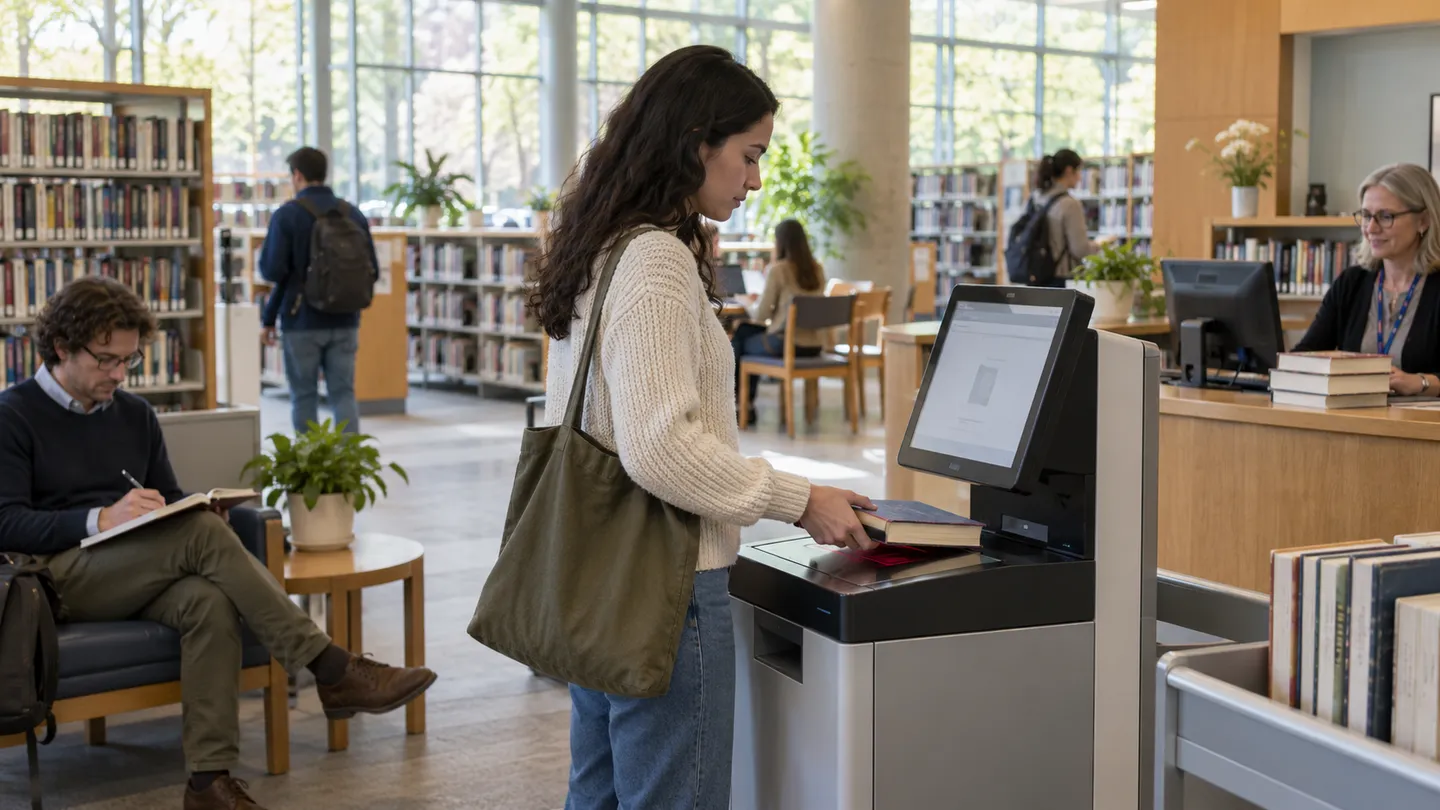
The library team begins with a question: “What happens between placing books at the self-checkout and leaving with a completed loan?” That is narrower and more observable than “Why are visitors confused?” The latter already interprets a person’s state.
Name where the activity starts and ends. Include the relevant equipment, available help, queue and accompanying people. If a visitor checks their library card before approaching the machine, that might matter to a wider borrowing question; it is outside a kiosk-only session unless the team deliberately expands the scope.
GOV.UK’s contextual research guidance describes observing activities in everyday environments and choosing whether to watch silently, ask occasional questions or invite a running explanation. Each approach offers different information and changes the task to a different extent.
Use the Double Diamond to locate what the evidence is for. Discovery observation can help frame a problem. Watching a proposed instruction during a concept test examines that intervention instead. Keep the two settings distinct when reporting.

Our library plans a bounded view of borrowing, with a researcher visible beside the kiosk and help available through the ordinary service desk. It will not infer what happens across every branch or when the researcher is absent.
Select situations that can answer the question
A convenient quiet morning may miss the circumstances that make borrowing difficult. Plan relevant variation in tasks, operating periods, experience and access needs. Include smooth activity as well as interruption; otherwise the team cannot examine what differs.
Use sampling to state the selection route. Purposeful observation might seek first-time borrowers, experienced users and people needing an adjustment. It should not be reported as an estimate of the percentage of all visitors who struggle.
Think about the unit of evidence. One visitor returning to the machine three times is not three independent people. Several tasks performed by the same staff member may share conditions. Retain that relationship in the record.
Talk with staff about which situations matter, using stakeholder mapping to find the people who receive the task’s consequences. Staff can identify a relevant handover, but their explanation remains a lead to investigate rather than a predetermined finding.
If the question concerns digital adoption after a rollout, vary the operating conditions that change readiness makes visible: access, support, workload and authority. Observing a demonstration in a quiet room cannot establish use during an ordinary shift.
Agree participation and what will be recorded
Explain who is researching, what will happen, how notes or recordings will be used and who can see them. Participation and recording are distinct choices. A person might agree to a researcher watching a task without agreeing to video.
GOV.UK’s informed-consent guidance includes purpose, observation, recording, voluntary participation and data handling. Apply your organisation’s approved research and privacy arrangements, including the route for withdrawal. The guidance’s government context does not supply a universal legal template for every library or workplace.
A public location does not make collecting everyone’s personal information necessary. Arrange the study so agreed participants can be observed without routinely capturing other visitors’ screens, names or conversations. If an unexpected person enters the activity, follow the approved arrangement rather than improvising wider recording.
In the hypothetical library, the researcher needs the sequence of book placement, checking and help. They do not need to publish the visitor’s borrowing history. Do not photograph a readable account screen simply because it would make the presentation more vivid.
Also explain to staff how the material will be interpreted. When observation is for service research, avoid quietly converting notes into an individual performance ranking. The scope of change contracting can help make that purpose and authority explicit.
Prepare a protocol and try it once
A protocol tells observers what to notice and how to record it. It should support attention without becoming so detailed that the researcher misses an unexpected event. Pilot the record in the actual environment where possible.
For the library, useful fields include session reference, task, context, time or sequence, event, help, participant explanation and uncertainty. Choose the level of detail needed for the question. If the decision concerns an unclear transition, exact stopwatch precision may add little; if it concerns waiting time, measurement procedures matter.
GOV.UK’s note-taking guidance recommends sticking to observations rather than personal interpretations and retaining participant and session references. It also distinguishes notes, photos and several recording modes. Select the least intrusive record that answers the question.
Use separate space for the researcher’s interpretation. Write “visitor looked from the screen to the help desk” as an event. Put “may be seeking confirmation” into the interpretation field and add a follow-up question. This keeps a plausible explanation from replacing what was actually seen.
If two researchers observe, agree basic event definitions and compare notes during a pilot. A second observer does not automatically eliminate bias; disagreement can show that the protocol or task boundary needs clarification.
Observe the sequence and handle interruptions honestly
Describe events in order, including what preceded a pause or workaround. “The visitor failed” is too broad to examine. A useful sequence might show a visitor placing several books, waiting, tapping a completion control and then looking towards staff.
Do not provide a helpful hint and later report the task as independently completed. If the researcher intervenes or staff provide help, record when and what happened. The intervention may be appropriate; it changes what the observed completion means.
Keep ordinary support available. Research should not leave someone struggling indefinitely merely to produce a dramatic example. Agree in advance how assistance, discomfort or an operational problem will be handled. A pause or early ending belongs in the data, rather than disappearing from the completion count.
If you ask questions during the task, distinguish the action before and after the interruption. A participant narrating each step can reveal interpretation while also doing a task differently from usual. The protocol should make that trade-off visible.
Use customer-interview follow-ups after the activity when an event is unclear. “What were you checking at that point?” allows an explanation. “Were you worried about making a mistake?” supplies one.
Separate events from explanations
The following original record uses an invented borrowing sequence. It shows why a finding needs more care than an impression recorded during a visit.
| Recorded event | Possible interpretation | Follow-up or comparison |
|---|---|---|
| Visitor places three books together | Expects the machine to accept a batch | Ask what the placement cue meant |
| Visitor taps completion while the screen is still changing | May not recognise a processing state | Check the instruction and another task |
| Visitor looks towards the staffed desk | May be seeking confirmation or other help | Ask what information was wanted |
| Staff points to the displayed loan result | Help clarifies this instance | Check whether the visitor can explain completion |
The researcher should not conclude that the visitor lacks confidence from the glance alone. They could be looking for a receipt, checking where to return another item or responding to somebody nearby. The observed sequence constrains an explanation without establishing it.
GOV.UK’s analysis guidance separates observations, findings and actions. Use that structure when reviewing the notes. A proposed instruction change is an action; “the processing state is not clear in these observed tasks” is a candidate finding; the event table is evidence to inspect.

Preserve a smooth case. A visitor who waited for the loan result without assistance may reveal a different instruction interpretation or prior experience. Do not remove that case just because it complicates the story.
Allow for the effect of being studied
Visitors may act more carefully when a researcher watches. Employees may explain or tidy a workflow they ordinarily perform with fewer visible steps. Questions, recording equipment and the observer’s position can all become part of the setting.
McCambridge, Witton and Elbourne’s systematic review examined research-participation effects associated with the Hawthorne-effect label. It found substantial variation in definitions, designs and circumstances. It does not supply a fixed correction factor to subtract from observed performance.
Record the research conditions. Were participants asked to think aloud? Did they know a manager was watching? Was the normal queue present? Compare the observation with relevant accounts or operational records when these address the same question, while noting that each has its own limitations.
Avoid declaring observation useless because behaviour may change. Instead, narrow the claim: what happened under these research conditions, which interpretation is plausible and which everyday condition still needs checking. Observation is evidence with a context, not an unfiltered view of ordinary life.
Turn a finding into a bounded next decision
The fictional library may now have a question about recognising task completion. It can inspect the displayed cue, compare relevant sessions and draft an alternative instruction. It should not jump from one observed pause to replacing the whole borrowing system.
Put the evidence into a journey map if the issue crosses the kiosk, receipt and service desk. Keep the uncertain interpretation marked. The map should help connect actions and handovers, not present an attractive final story that has lost its source references.
Use assumption mapping if the proposed change rests on an untested explanation. For example, “visitors need a clearer completion cue” differs from “staff need more training”. Select the next check according to which explanation would change the response.
A later survey might describe reported experience across a suitable population, but it cannot retrospectively turn the observed visitors into a representative sample. Keep discovery, measurement and intervention testing accountable to their own designs.
Evidence and limitations
Observation reveals activity available to the observer. It may miss preparation, private reasoning, rare events and consequences outside the session. Recording and analysis select what becomes visible to other people, so maintain references and explicitly label uncertainty.
The institutional sources provide research practice guidance. The systematic review supports caution about participation effects without predicting the effect in this library. All task sequences and proposed actions here are hypothetical.
A useful observation report identifies the question, participants or situations, research conditions, sequence, interpretation and next decision. Its strength comes from showing how a conclusion was reached and where another explanation still deserves examination.
Sources:
- GOV.UK User research community (2017). Contextual research and observation.
- GOV.UK User research community (2017). Taking notes and recording user research sessions.
- GOV.UK User research community (n.d.). Getting informed consent for user research.
- GOV.UK User research community (2016). Analyse a research session.
- Jim McCambridge, John Witton and Diana R. Elbourne (2014). Systematic review of the Hawthorne effect: New concepts are needed to study research participation effects.