In this guide
- 01Observation
- 02Source check
- 03Tentative pattern
- 04Decision or inquiry
Trend scouting is the deliberate search for signs of change that could matter to a particular decision or opportunity. It combines noticing, documenting, checking and interpreting. The useful output is not a collection of impressive predictions. It is a traceable account of what may be changing, why you think so and what the organisation should investigate next.
A signal is an observation that may indicate change. A trend is a pattern developing over time. A driver is a possible explanation for that pattern. Keeping these separate helps prevent a product launch, a social-media post or a memorable conversation from becoming an unsupported claim about the future.
Begin with a question worth scanning for
Consider a fictional household-goods repair business exploring whether it should develop a spare-parts service. Its scanning question is: “What changes could make repairing common household products easier or harder for our customers over the next three years?” That is more useful than asking someone to collect “the latest innovation trends.”
The scope identifies a group, an activity and a period. It also leaves room for different kinds of change: product design, parts access, repair skills, customer expectations and service arrangements. The business is not simply searching for evidence that its preferred spare-parts platform should be built.
The Futures Toolkit describes horizon scanning as a way to identify emerging issues and possible opportunities or threats. Use that exploratory purpose as a boundary. A scan can justify a question without justifying an investment.
Agree who will use the findings and when. A quarterly strategy review and an imminent supplier decision need different outputs. If nobody owns a decision the scan could influence, the work may become an interesting reading service with little practical effect.
Build a varied source route
Combine sources that see different aspects of the situation. For the repair business, useful routes could include manufacturer documentation, independent repair observations, customer enquiries, research institutions, supplier information and relevant official publications. Each has a different perspective and limitation.
Commercial sources can reveal what is being offered, but their claims need checking. A vendor is well placed to describe a demonstration; it is not necessarily an independent source for market-wide adoption. Repeated media coverage may trace back to the same announcement.
Use PESTEL to check whether attention is concentrated too narrowly. CIPD’s description of the framework offers a useful reminder to look beyond technology at external social, economic and other conditions. Do not fill categories mechanically; use them to notice blind spots.
Include people near the work. A repair technician may notice an increase in sealed components before a strategy team sees the issue in a report. Treat the observation as a lead to investigate, not automatically as a representative trend.
Make a signal record while the context is fresh
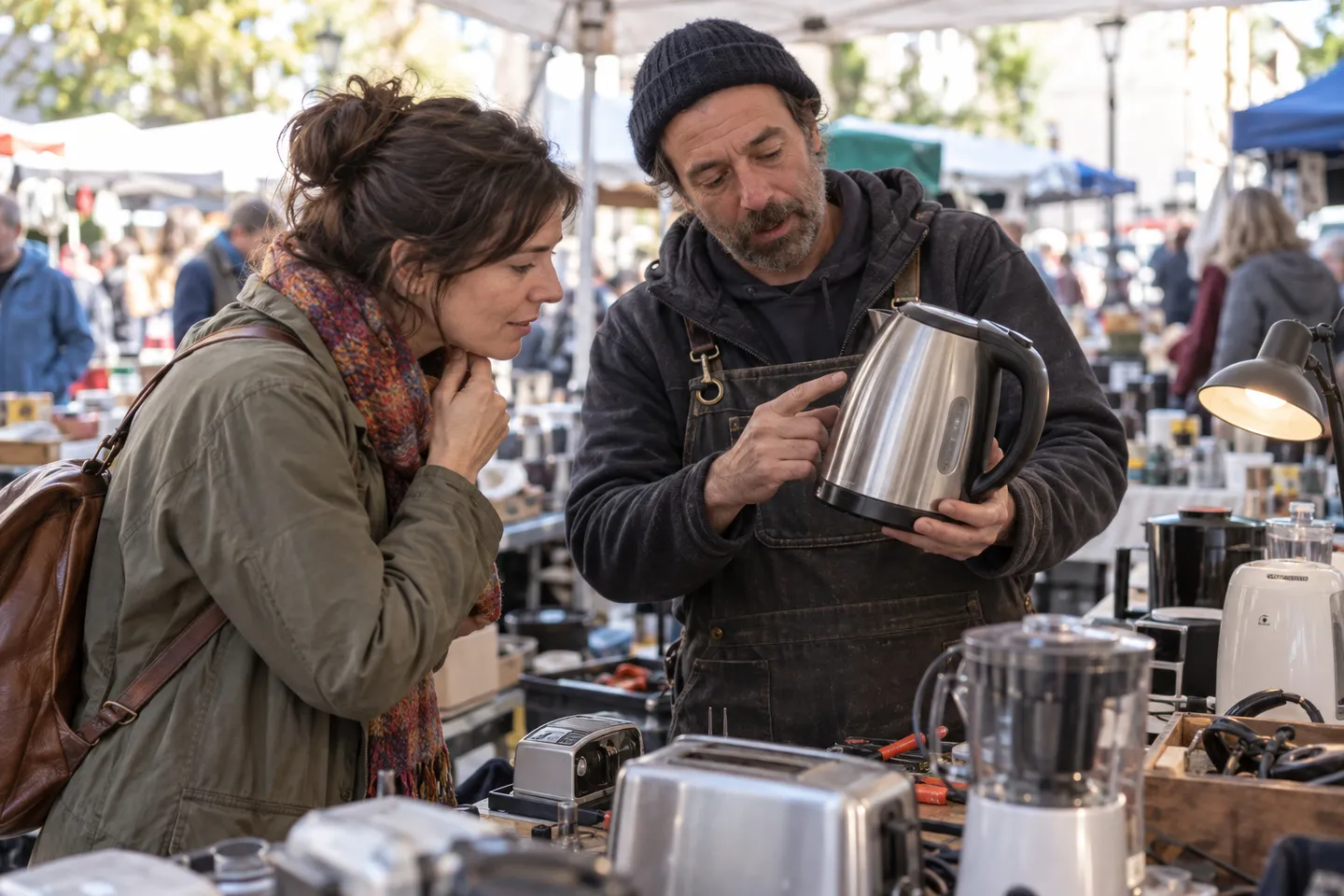
At a fictional household-goods fair, a researcher watches a vendor demonstrate a replaceable kettle handle. The useful record says what was shown, by whom, when and under which conditions. It also says what was not established: product availability, durability, compatibility, customer demand or repair safety.
The Government Office for Science’s scanning template includes a description, sources, relevance, time horizon and uncertainty. A short record with those elements is more reusable than a photograph saved in an unlabelled folder.
Separate the original observation from your interpretation. “A vendor demonstrated a replaceable handle” is narrower than “household products are becoming repairable.” The second claim would need a wider body of evidence and a clear definition of what counts as repairability.

Add the next check while you still remember why the signal interested you. That might be obtaining technical documentation, checking availability or asking repairers whether the design addresses a common failure. Avoid collecting material indefinitely without deciding how it will be examined.
Check independence, relevance and status
Open the original source whenever possible. Find out whether the claim concerns a prototype, a commercial offer, a limited trial or routine use. Check the date and whether the development applies to your geography, product class and customers.
Then follow the evidence chain. Five articles quoting one press release are not five independent observations. A manufacturer announcement, a repairer’s documented experience and customer behaviour may provide different forms of evidence, although they still need scrutiny.
GOV.UK’s research-analysis guidance separates what was observed from what a team concludes. Apply the same discipline to scanning: preserve source statements, write interpretations separately and record uncertainty rather than removing it during summarisation.
For safety, legal or technical claims, involve qualified reviewers and current authoritative sources. The kettle example here is not repair instruction. A replaceable-looking component is not evidence that a repair is safe, permitted or suitable for an untrained user.

Look for a pattern and for what contradicts it
Cluster related signals, but do not force them into a single story. A new spare-parts offer, a repair-training programme and customer enquiries about maintenance could all relate to repair access. They may also concern different products, groups and economic conditions.
Ask what would count against the emerging interpretation. Are parts still unavailable for common models? Do customers abandon repairs because of delay? Are demonstrations concentrated in a small premium segment? Counter-signals help define the boundary of a pattern.
The following invented record shows how a tentative interpretation can remain useful without becoming a forecast.
| Item | Observation or question | What it contributes |
|---|---|---|
| Demonstration | A replaceable handle is shown at a fair | A possible design direction |
| Workshop experience | Technicians report difficulty identifying parts for older models | A constraint on practical repair |
| Customer enquiry | Some customers ask about repair before replacement | A reason to investigate decision criteria |
| Missing evidence | No verified pattern of repeated purchases or use | A boundary on demand claims |
| Next inquiry | Compare recent repair journeys across several product types | A way to test whether the issue is broader |
Give the cluster a cautious name such as “changing conditions for spare-parts access,” not “the inevitable repair revolution.” The former invites investigation. The latter makes disagreement sound like ignorance.
Explain the possible mechanism
A pattern becomes strategically interesting when you can explain how it might affect the business. Easier part identification could reduce diagnostic work. Longer delivery times could make repair less attractive even when parts exist. Training requirements could constrain who can perform the work.
Write the chain in plain language and identify where it depends on assumptions. For example: if parts become easier to identify, and suppliers can deliver them within customers’ acceptable waiting time, then a repair service may become more practical. Each condition needs evidence; none follows automatically from a product announcement.
Consider alternative explanations. More customer enquiries could reflect better publicity, a temporary replacement shortage or a change in the shop’s own communication. The observation may still matter, but the explanation changes what the organisation should do next.
This is where customer interviews and operational research complement scanning. The external signal provides a question; local investigation checks how it connects with actual situations.
Convert the scan into decisions
For each important cluster, choose between deeper research, a bounded experiment, monitoring or no action for now. Explain the choice. Not every interesting development deserves a project.
The repair business might define an opportunity field around making spare-parts identification easier. It could investigate whether identification, delivery or repair skill is the limiting problem before choosing a concept. That is a more useful outcome than compiling a list of fashionable technologies.
Where several developments could combine in different ways, use scenario planning to examine the consequences. Where a narrow assumption can be tested, arrange the test. Do not use uncertainty about the distant future as a reason to avoid answerable questions today.
Give monitoring a concrete owner and trigger. “Review the availability of parts for the models our customers actually bring in before the next service decision” is better than “keep an eye on repair trends.”
Maintain the record and its limits
Schedule a review of the scanning question, source mix and active clusters. Retire claims that are outdated, irrelevant or unsupported. Preserve why a promising lead was rejected so the same publicity does not repeatedly return as a new discovery.
Trend scouting is vulnerable to novelty bias, selective sources, commercial hype and retrospective storytelling. A plausible interpretation is not a probability estimate. A well-documented signal may never develop into a wider pattern.
The approach is most useful when it improves the timing and focus of investigation. It is less useful when it becomes a demand to predict the next big thing. The practical test is simple: can someone trace the evidence, understand the uncertainty and explain which decision the scan now helps them make?
Sources:
- Government Office for Science (n.d.). The Futures Toolkit.
- Government Office for Science (n.d.). Horizon Scanning: template.
- CIPD (n.d.). PESTLE analysis.
- GOV.UK User research community (n.d.). Analyse a research session.