
In this guide
- 01Understand
- 02Explore
- 03Apply
- 04Reflect
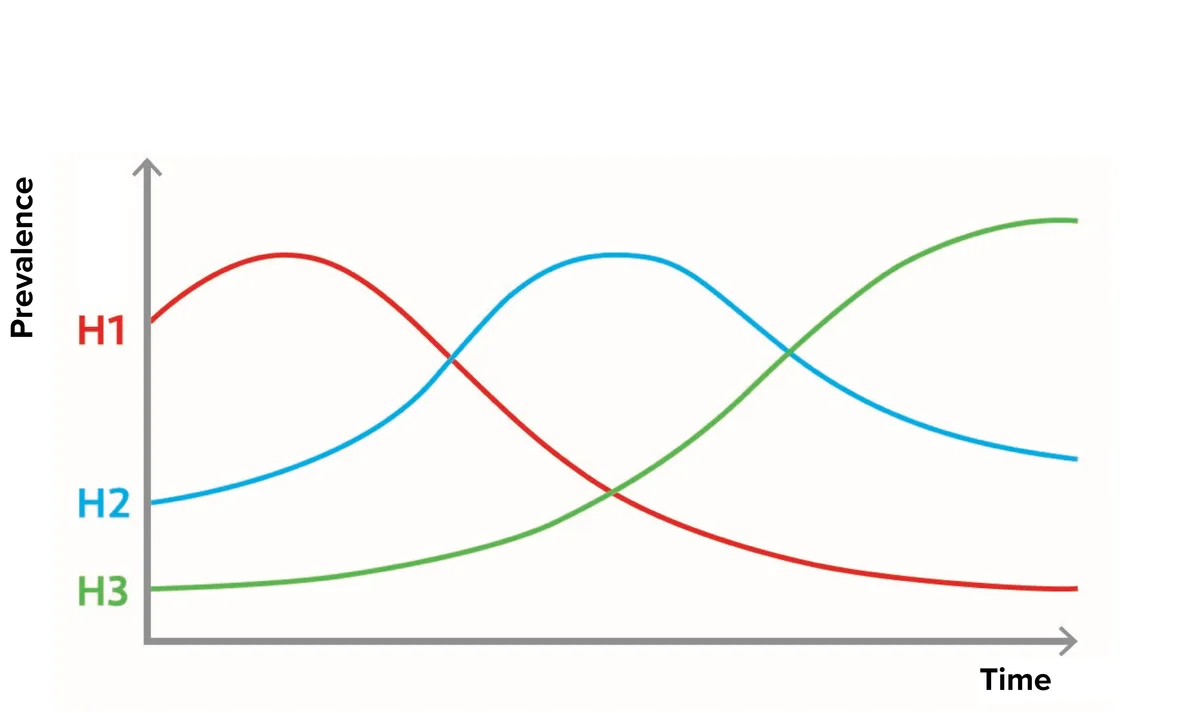
“Three Horizons” names two related but different tools. The better known is a growth portfolio model from The Alchemy of Growth (1999) by Mehrdad Baghai, Stephen Coley and David White of McKinsey. Horizon 1 is the profitable core, Horizon 2 holds emerging businesses that need investment, and Horizon 3 holds small options on future businesses. It asks whether you are managing all three at once, each in a way that suits it.
The second version, developed by futures practitioners including Bill Sharpe, Anthony Hodgson and Andrew Curry, asks something else. Horizon 1 is the current way of doing things as it loses fit with changing conditions, Horizon 3 is an emerging pattern that could replace it, and Horizon 2 is the unsettled space of transitional innovations between them. Which of those innovations lead towards the new pattern, and which only prolong the old one?
Neither version is a calendar or a budget formula. A horizon is not “the next twelve months”, and 70/20/10 is a heuristic from one study, not a rule. Use the growth model to decide how each initiative should be managed, and the futures model to check whether your innovation is moving you anywhere. A fictional heating installer shows why many businesses need both.
The growth model: three kinds of business at once
McKinsey’s “Enduring Ideas” summary presents the framework as a way to manage current performance while building future growth. Horizon 1 contains the core businesses that provide most of the profit and cash; the task is to improve their performance and capture their remaining value. Horizon 2 contains emerging opportunities that could become substantial profit sources but may need considerable investment. Horizon 3 contains ideas for later growth, such as research projects, pilots or minority stakes in new ventures.
The diagram has a time axis, so it is often read as a schedule. The summary rejects that reading: time is not a prompt for when to pay attention, and all three horizons must be managed concurrently as businesses mature from Horizon 3 towards Horizon 1. It also warns that urgent Horizon 1 concerns can easily overwhelm work that matters for the future.
Steve Blank sharpened the time point in his 2019 Harvard Business Review article. Some organisations, he notes, had attached delivery times to the horizons, such as three to twelve months for Horizon 1 and three to six years for Horizon 3. He argues that the horizons “are no longer bounded by time”, citing new entrants that put existing technology into new business models quickly. He still calls the model a useful shorthand for prioritising innovation initiatives, and says each horizon requires different focus, management, tools and goals.
Under the version on Blank’s blog, a comment signed by Mehrdad Baghai as co-author, whose points Blank accepted, objects that the model is a growth strategy framework, not an innovation framework. Its horizons concern the nature and timing of revenue and earnings, and each company sets its own timing. The comment cites some forest-products firms placing Horizon 3 ten to twenty years away and semiconductor firms eighteen months. A disruptive innovation can sit in Horizon 1 if it earns now.
In practice, a horizon describes where a business sits in the growth pipeline, on a timescale suited to your industry, and therefore how it should be run. It is not a synonym for disruption, as our comparison of disruptive and radical innovation explains.
The futures model: a pattern losing fit
The futures version maps patterns in a system, not businesses in a portfolio. Sharpe and colleagues’ 2016 paper in Ecology and Society describes Horizon 1 as “business as usual”, and says the conversation begins by recognising that this pattern is losing its fit with emerging conditions. Horizon 3 is the emerging pattern that could succeed it, visible now only at the margins as “pockets of the future in the present”. Horizon 2 is the turbulent zone of transitional activities in between.
Within Horizon 2, some innovations, labelled H2+, open the way towards Horizon 3. Others, H2−, are absorbed back into Horizon 1 and “prop up” the existing pattern. The authors stress that the label is explored rather than absolute, and that an H2− move is not automatically wrong: a more efficient old system can be sensible without being a transition.
The International Futures Forum’s H3Uni tutorial explains why facilitators usually take the horizons in the order H1, H3, H2: without a picture of the third horizon, you cannot tell sustaining from transformative innovation. It describes Horizon 1 protecting itself by crushing new practices or co-opting them, and says structural change matters more for strategy than the span of years. Curry and Hodgson’s 2008 paper adds that the period a horizon covers depends on the subject: they suggest the third horizon for energy security lies about fifty years out, and nearer for computing.
The Government Office for Science’s Futures Toolkit turns this into a workshop: Horizon 1 assumptions, emerging Horizon 3 changes, Horizon 2 responses, then a written record. It suggests at least ten varied participants and at least three and a half hours in person. Its warning that the main difficulty is helping people grasp “three different time horizons” shows how easily the calendar reading returns.
How the two versions differ in use
Curry and Hodgson’s abstract says the futures method “differs significantly” from the original management version. Trouble starts when a team draws the familiar curves, cites one lineage and uses the other.
| Aspect | Growth portfolio model | Futures model |
|---|---|---|
| Question it answers | Are we running today’s profits, emerging businesses and options together? | What is losing fit, what might replace it, and which innovations help the shift? |
| Horizon 1 | The profitable core, run for performance | Business as usual, losing fit |
| Horizon 2 | Emerging businesses that need investment | Transitional innovations, H2+ or H2− |
| Horizon 3 | Small options on future businesses | An emerging pattern, visible now in pockets |
| Typical use | Portfolio reviews, funding and management design | Facilitated strategy or policy dialogue |
| Common misuse | Treating horizons as fixed year counts or a fixed budget ratio | Treating a vivid vision as a forecast, or labelling people by horizon |
In the growth model, Horizon 1 is something to protect and improve. In the futures model, it is something whose decline you plan for, while deciding what is worth keeping.
A fictional heating firm tries a tidy split
Consider a fictional family-owned heating firm. Ruth, the owner, took it over from her father. Its Horizon 1 is boiler installation and servicing: service contracts, winter callouts and replacement boilers pay the wages. Declan, the service manager, runs that business well and is judged on response times and margin per job.
Heat-pump installation and retrofit advice form Horizon 2, which mixes product and process change. Enquiries are rising, but surveys take longer and the two technicians involved, Amira and Joe, are still training. Horizon 3 holds two possibilities: a small neighbourhood heat network with a local housing association, or a heat-as-a-service subscription in which customers pay for agreed warmth instead of buying equipment.
After reading about 70/20/10, Ruth announces that seventy per cent of development effort will go to the core, twenty to heat pumps and ten to “the future”. Nobody knows what the percentages apply to; the scarce resource is technician days and Ruth’s attention, not cash.
The first cold spell exposes the gap. Breakdowns pile up, and Declan pulls Amira and Joe back onto callouts, a defensible choice given the firm’s contract promises. Their training slips, two heat-pump surveys are postponed and one customer goes elsewhere. At the monthly review, heat-pump jobs look poor on margin per technician day. Meanwhile Ruth has spent several afternoons on a heat-network concept board that informs no decision.
Nobody has behaved badly. The firm has one management system, built for Horizon 1, and applies it to all three.
Sort the portfolio by maturity, not by year
Ruth starts again by listing every initiative competing for time, including improvements to the core. For each, the team asks: does it earn money now, with customers and routines we understand? Is demand emerging while delivery is still being worked out? Or is its main output, for now, learning? The answers decide the horizon, not a fixed count of years.
| Initiative | Horizon | What it must show next |
|---|---|---|
| Faster winter breakdown response | 1 | Contract promises kept through a cold spell |
| Remote monitoring of serviced boilers | Disputed: 1 or 2 | Fewer wasted visits, better renewals |
| Heat-pump installation | 2 | Repeatable installs without callbacks |
| Retrofit surveys and advice | 2 | Customers act on the advice |
| Neighbourhood heat network | 3 | Whether a partner and enough households would commit |
| Heat-as-a-service subscription | 3 | Whether customers value warmth over ownership, and who carries the risk |
Declan sees remote monitoring as a new growth line; Ruth sees it as a better way to run the boiler business. Record the dispute rather than forcing a vote; the futures lens will help.

Give each horizon its own management
Sorting only helps if it changes how work is run. Nagji and Tuff’s 2012 HBR article uses the related categories of core, adjacent and transformational innovation and argues that managing them takes different talent, organisation, funding and metrics, especially for transformational work. They suggest funding core and adjacent work through annual business-unit budgets, funding transformational work from above the annual budget contest, and not judging early transformational efforts by measures such as net present value.
For Ruth’s firm, an original planning aid, not a standard, might look like this.
| Element | H1: boiler service | H2: heat pumps and retrofit | H3: network or subscription |
|---|---|---|---|
| Metrics | Response time, first-time fix, margin | Survey-to-install conversion, callbacks, comfort after the first winter | Questions answered, partner commitment |
| Funding cadence | Annual budget, monthly control | Quarterly, tied to installer capacity | Small tranches, one question at a time |
| Leadership | Declan | Amira coordinating, Ruth as sponsor | Ruth, with a named review partner |
| Tolerance of failure | Low: missed promises hurt customers | Moderate on speed; none on safety or comfort | High for ideas; none for misleading customers |
Different metrics do not excuse Horizon 2 from scrutiny; they judge it on what it must prove next. An early heat-pump installation that takes much longer than a boiler swap is expected; one that leaves a household cold is not. For Horizon 3, use staged funding that pays for the next answer, not a budget for the whole vision.
Stop the core from starving the future
Horizon 1 wins most contests for resources: its returns are near and measurable, and its customers phone when something breaks. James March’s 1991 paper on exploration and exploitation makes a related argument formally: adaptive processes, which refine exploitation faster than exploration, are likely to be effective in the short run but self-destructive in the long run.
The firm’s responses are modest. It protects named weeks of Amira’s and Joe’s time and agrees what cover Declan can call on then. Ruth makes Declan a partner in Horizon 2, not its gatekeeper: his business funds everything else, and he knows which customers will ask about heat pumps first.
Sharpe and colleagues describe a “manager” mindset that keeps the current system running, an entrepreneurial one that seizes opportunities and a “visionary” one that holds a different future in view. They report that tension eases when each side sees why the others matter. Treat these as perspectives anyone can take, not labels for people; Declan’s objections about capacity are information, not obstruction.
Keep Horizon 3 from becoming a showcase
The opposite failure is a Horizon 3 that becomes a vanity lab: concept boards without a decision date, partner meetings that produce enthusiasm but no commitment, options that never draw on the firm’s real capabilities. Ruth’s heat-network work had drifted that way.
She now gives each option one question, an owner, a small budget and a review date. For the network: would the housing association and enough residents in one street commit, and who would own and maintain the pipes? Because it depends on a partner, it needs the disciplines of open innovation: a clear brief and explicit reasons for each side to take part.
For the subscription: would contract customers value paying for warmth, and could the firm carry the risk of breakdowns and changing energy costs? That is a business-model question before it is a technical one, and its first test can be far smaller than a pilot, as our comparison of MVPs and prototypes explains.
Ask which second-horizon moves lead somewhere
Now switch lenses: where are the Horizon 2 moves taking the firm? Following the Toolkit’s order, the team starts with Horizon 1 assumptions that may be losing fit: households replace a failed boiler like for like, the emergency callout is the main sales moment, and a technician’s training lasts a career. A PESTEL scan shows which outside conditions press on those assumptions; check regulation and grants with qualified sources, as this fictional example makes no claims about them.
Next they look for pockets of Horizon 3 today: a customer who has run a heat pump for two winters, the housing association’s interest in shared heat, landlords asking about whole terraces. Treat these as signals to check, as in trend scouting, not proof of where the market is going. Only then do they sort the Horizon 2 moves.
| Horizon 2 move | How it could prop up H1 (H2−) | How it could lead towards H3 (H2+) |
|---|---|---|
| Remote boiler monitoring | Makes boiler contracts cheaper to run and harder to leave | Builds data skills a heat service might need |
| Hybrid heat pump and boiler | Sold as a way to keep the boiler indefinitely | Designed as a step towards heat-pump-only running |
| Retrofit surveys | A pitch for the next boiler | A record of each home’s readiness for low-temperature heating |
| Technician training | A one-off certificate | A lasting capability for heat pumps and shared heat |
The same move can sit on either side depending on its design, which is why the label is explored rather than assigned. The firm keeps remote monitoring as a sensible Horizon 1 improvement, funded and measured as such, but stops calling it the firm’s future. It redesigns the hybrid offer so every survey records whether the home could later run on a heat pump alone. Neither decision required forecasting the year boilers fade.
Treat budget splits and year counts as prompts
Nagji and Tuff report that, in their study of industrial, technology and consumer-goods companies, firms allocating about 70 per cent of innovation activity to core initiatives, 20 to adjacent and 10 to transformational ones tended to outperform peers on share-price measures. They call this an average allocation, not “a magic formula”, and say the right balance varies with industry, competitive position and stage of development.
That is a correlation with share-price performance, not evidence that the split causes growth. It cannot tell a small heating installer how to divide technician days, and our innovation management guide likewise recommends no universal ratio. A better question for Ruth is what the firm will stop or slow to protect Horizon 2 training, and which choices in its innovation strategy justify that.
Year counts deserve the same treatment. The Baghai comment’s examples run from eighteen months to twenty years, and Curry and Hodgson’s differ by field. If you set a timescale, set it for your industry and revisit it; otherwise attach dates to decisions and reviews.
Limitations and evidence
McKinsey’s summary and the blog comment signed by Baghai establish what the growth model says, not that firms using it grow faster. The 70/20/10 evidence is correlational, and March’s paper is a modelling study cited for a mechanism. Sharpe and colleagues state plainly that their paper does not test whether Three Horizons works; it reports facilitators’ reflective practice and notes that facilitation skill strongly affects the depth of insight.
Neither model tells you where to look or which option will succeed; use search fields to direct the search. Sharpe and colleagues report that scenario practitioners use Three Horizons to frame a project and scenarios to explore the uncertainties within and between horizons, so pair it with scenario planning when Horizon 3 is genuinely uncertain.
Horizons can also harden into labels for people or teams, undermining the dialogue the futures version exists to support. The heating firm, its staff and its decisions are invented for teaching and report no results. Nothing here is advice on heating technology, regulation or subsidies.
As a first step, list the initiatives competing for your scarcest capacity, sort them by maturity and note what each must show next. Then ask of every Horizon 2 move: towards what?
Sources:
- McKinsey Quarterly (presented by Stephen Coley) (2009). Enduring Ideas: The three horizons of growth.
- Steve Blank, Harvard Business Review (2019). McKinsey's Three Horizons Model Defined Innovation for Years. Here's Why It No Longer Applies..
- Comments signed by Mehrdad Baghai, on Steve Blank's blog (2019). Comments on “The Fatal Flaw of the Three Horizons Model”.
- Bill Sharpe, Anthony Hodgson, Graham Leicester, Andrew Lyon and Ioan Fazey (2016). Three horizons: a pathways practice for transformation.
- Andrew Curry and Anthony Hodgson, Journal of Futures Studies (2008). Seeing in Multiple Horizons: Connecting Futures to Strategy.
- Government Office for Science (2024). The Futures Toolkit.
- International Futures Forum, H3Uni Resource Library (n.d.). Three Horizons (H3Uni tutorial).
- Bansi Nagji and Geoff Tuff, Harvard Business Review (2012). Managing Your Innovation Portfolio.
- James G. March, Organization Science (1991). Exploration and Exploitation in Organizational Learning.